







Is Noah's Flood True?
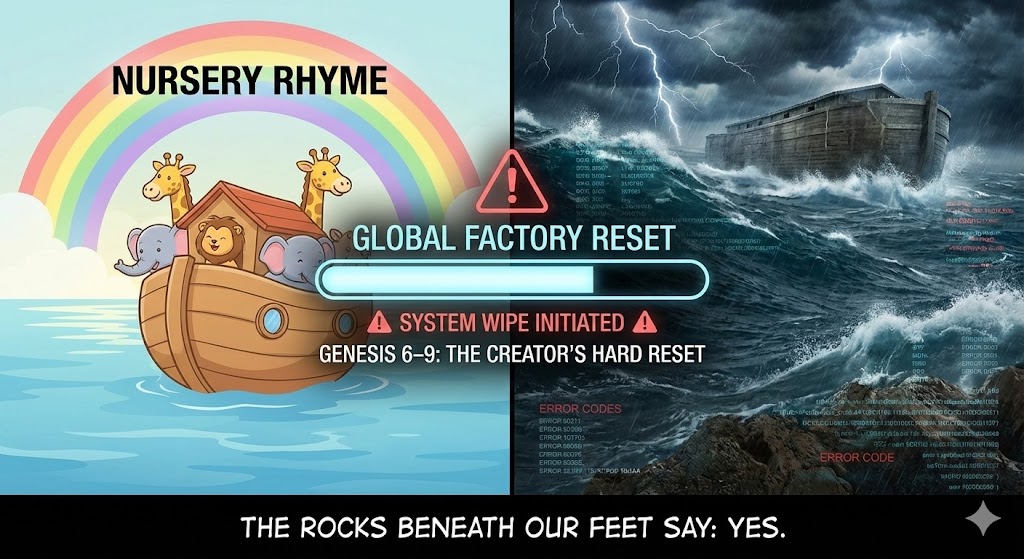
To the skeptics, the history buffs, and everyone looking for the truth:
Is Noah's flood true? Most of modern society treats the story of Noah’s Flood like a nursery rhyme. We picture a cute little boat with giraffes sticking their heads out of the window, floating on a gentle sea. But if you read the actual account in the Bible (Genesis 6–9), it was not a petting zoo cruise. It was a global wipe and a fresh start.
When something is so broken that small fixes will not work, you have to start over. The Bible says that is what happened to the world.
The Bible says humanity had become so full of violence and evil that the Creator had to reset the earth to save it. In this paper we are not asking "Did a boat float?" We are asking: Is there evidence that this planet was wrecked by water on a global scale?
The rocks beneath our feet say: Yes.
1. It Was Not Just Rain
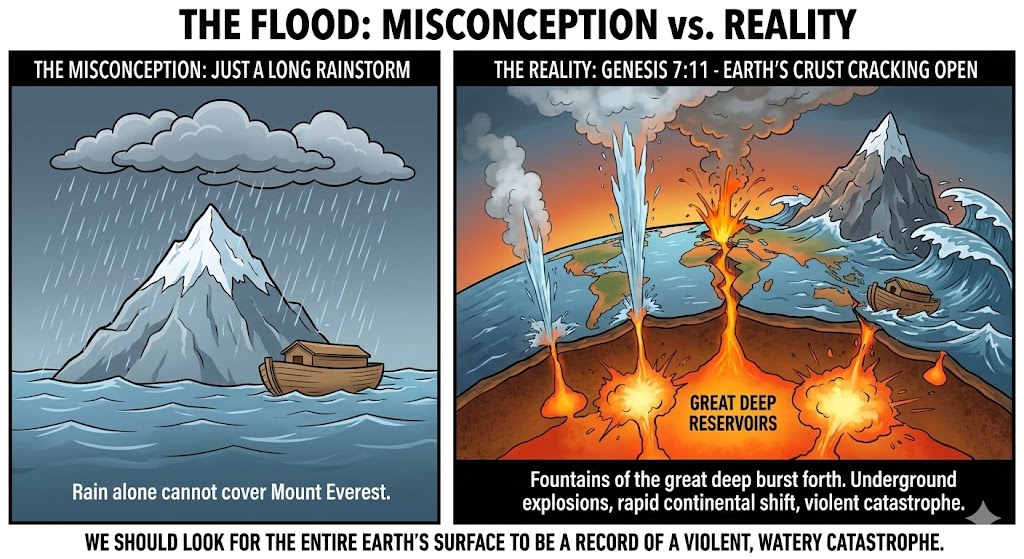
One of the biggest misconceptions is that the Flood was just a really long rainstorm. Rain alone cannot cover Mount Everest. But the Bible describes something much more violent.
- What the Bible says: Genesis 7:11 says, "all the fountains of the great deep burst forth."
- What that points to: That is not only storm clouds; it is the earth's crust cracking open. Huge underground stores of water and magma burst upward. That could have made the continents break apart and move quickly, not slowly over millions of years.
If this happened, we should not look for a "flood layer" of mud in your backyard. We should look for the entire earth's surface to be a record of a violent, watery catastrophe.
2. The Evidence: Same Layers Across Continents
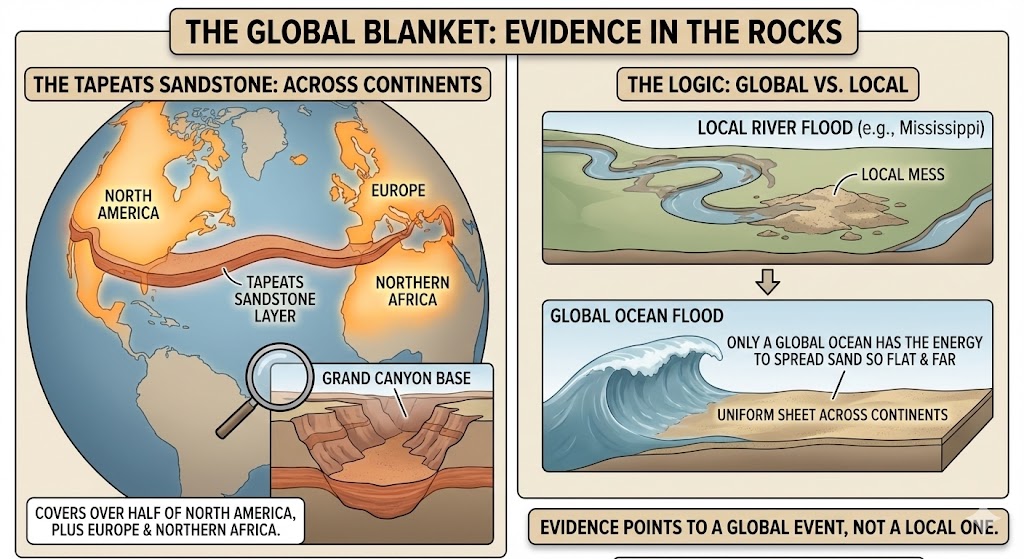
In our last file, we talked about the flat rock layers of the Grand Canyon. But the evidence is actually much bigger than that.
- The big picture: We find the same thick layers of sand and rock stretching across entire continents.
- Tapeats Sandstone: There is a specific layer of sandstone at the bottom of the Grand Canyon. But it does not stop there. It covers over half of North America. We find the exact same layer in Europe and Northern Africa.
- Why that matters: A local river flood (like the Mississippi flooding) leaves a local mess. It does not lay down one even sheet of sand across four continents. Only a global ocean, rising and moving powerfully over the land, could spread that much sand so flat and so far.
3. The Fossils: Buried Alive
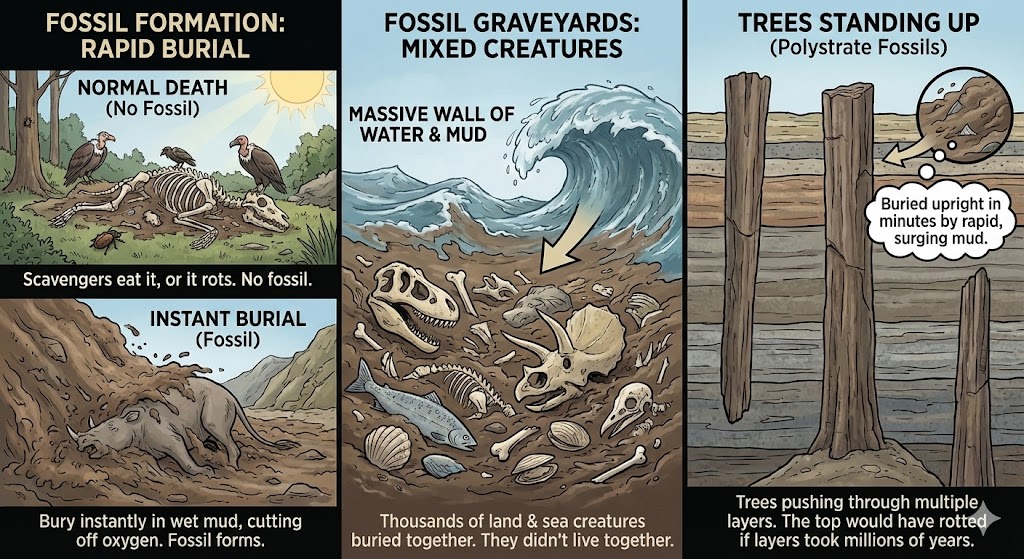
How do you make a fossil? You don't make one by an animal dying in the woods. Scavengers eat it, or it rots away. To get a fossil, you must bury something instantly in wet mud so that oxygen can't get to it.
- Fossil Graveyards: We find massive "graveyards" all over the world where thousands of dinosaur bones are mixed together with clams, fish, and birds.
- The question: Why are land animals (T-Rex) buried in the same hole as deep-sea creatures? They did not live together.
- The answer: They were thrown together. A massive wall of water swept them up, put them in a blender of mud and rock, and dumped them in a pile.
- Trees standing up through rock: We find fossilized trees standing straight up, passing through many layers of rock (these are sometimes called polystrate fossils).
- The problem for slow formation: If those rock layers took millions of years to form, the top of the tree would have rotted away long before the rock formed around it.
- What fits: The tree was buried upright in a short time by fast, surging mud.
4. Shared Memory: Flood Stories Around the World
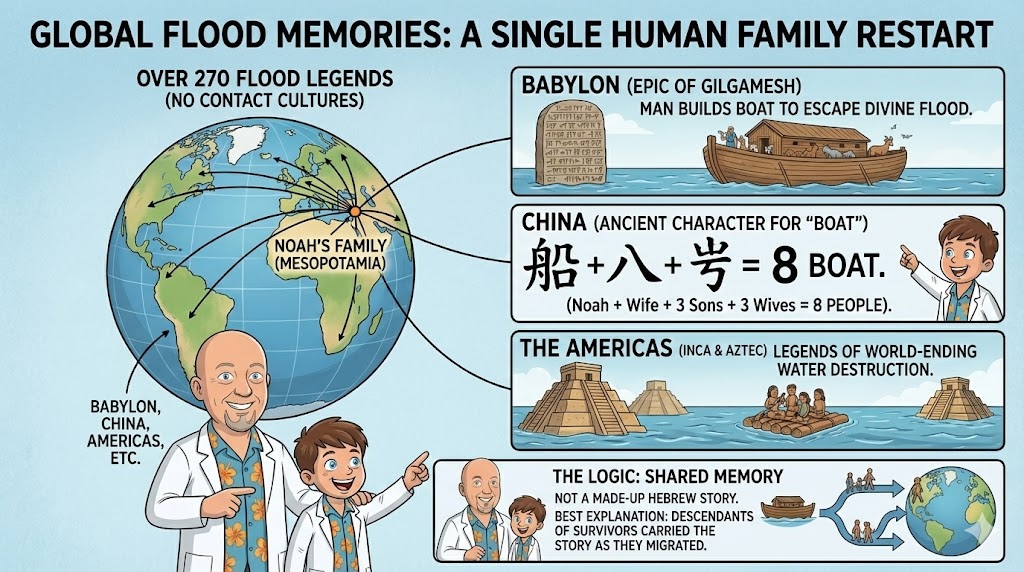
If the human race really restarted from a single family (Noah’s), then every culture on earth should have a memory of this event. And they do.
- The facts: Anthropologists have found over 270 flood legends from cultures that had no contact with each other.
- Babylon (The Epic of Gilgamesh): Describes a man building a boat to escape a divine flood.
- China: The ancient character for "Boat" consists of the symbols for "Vessel," "Eight," and "Mouths" (People). Noah + his wife + 3 sons + 3 wives = 8 people.
- The Americas: The Incas and Aztecs both have legends of a world-ending water destruction.
- Why that matters: If the Flood was just a story made up by the Hebrews, why do the Aztecs have one too? The best explanation is that they are all descendants of survivors who carried the story with them as they spread around the world.
5. Why the Reset?
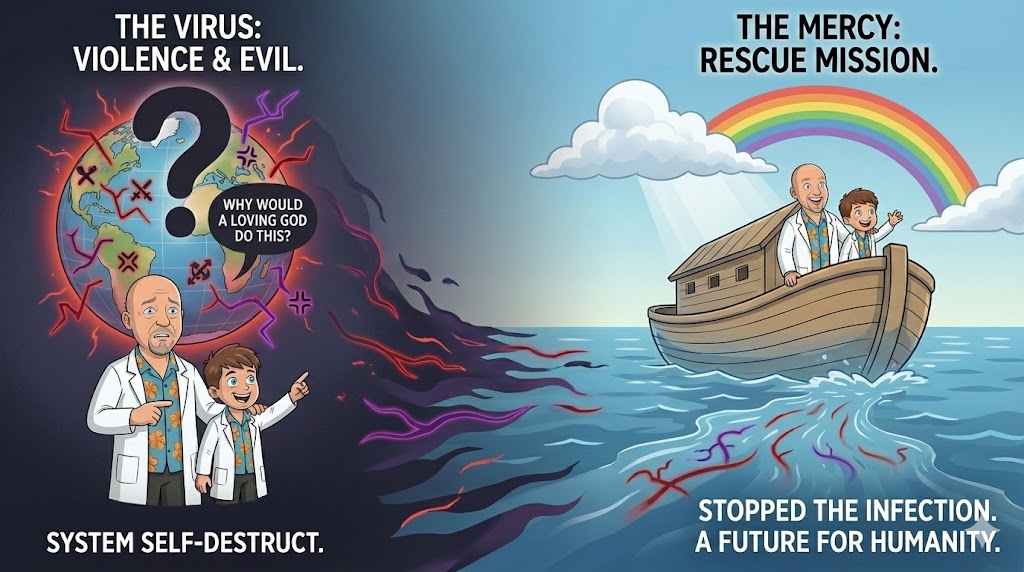
Why would a loving God do this? This is the question that stops most people.
- What had gone wrong: Genesis says the world was full of violence. The human heart was bent toward "evil all the time." Things were headed toward ruin.
- The mercy: The Flood was not only punishment; it was a rescue. God put a stop to the corruption so humanity could have a future. He did not want to lose us forever.
6. Conclusion: The Lifeboat
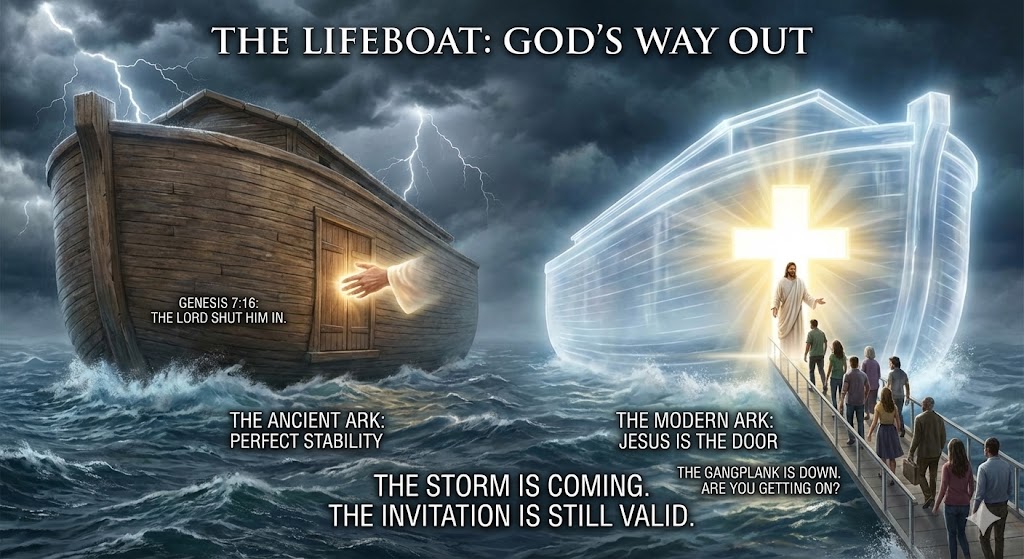
The most important part of the Flood account is not the water; it is the Ark.
God did not only wipe the world; He provided a way out. He gave humanity a way to survive the storm.
- The design: The Ark’s dimensions in the Bible are the right ratio for stability in rough seas. Naval engineers have said it would be almost impossible to capsize.
- The door: There was only one door into the Ark. Noah did not close it; God did. Genesis 7:16 records, "Then the Lord shut him in." That was not just a door; it was a seal that no one could open.
Today, the world can feel unstable again. But God has provided another way to be saved. This one is not made of wood.
Jesus is the door. The storm is coming, but the invitation to "Come aboard" is still open. You do not have to face the end alone.
The way in is open. Are you getting on?