
PREFACE: THE ANALYST'S NOTE
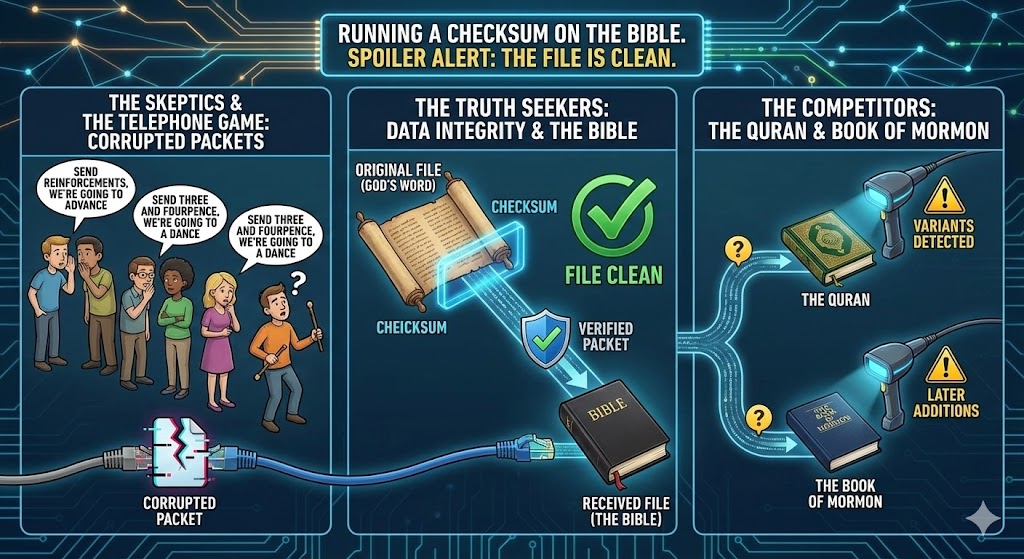
To the Skeptics, the Truth Seekers, and anyone who thinks the Bible is just a copy of a copy of a copy:
In the world of computer science, Data Integrity is everything. If you send a file across a network, you need to know that the file arriving at the destination is exactly the same as the one that was sent. You don't want a "corrupted packet."
The most common objection I hear against the Bible is the "Telephone Game." You know the game: one person whispers a phrase to another, and by the time it reaches the end of the line, "Send reinforcements, we're going to advance" turns into "Send three and fourpence, we're going to a dance."
People assume the Bible has been hacked, edited, and corrupted over 2,000 years.
In this file, we are going to run a Checksum on the Bible. We will compare its transmission system to its primary competitors: The Quran and The Book of Mormon.
Spoiler Alert: The file is clean.
1.0 The Transmission System: Decentralized vs. Centralized
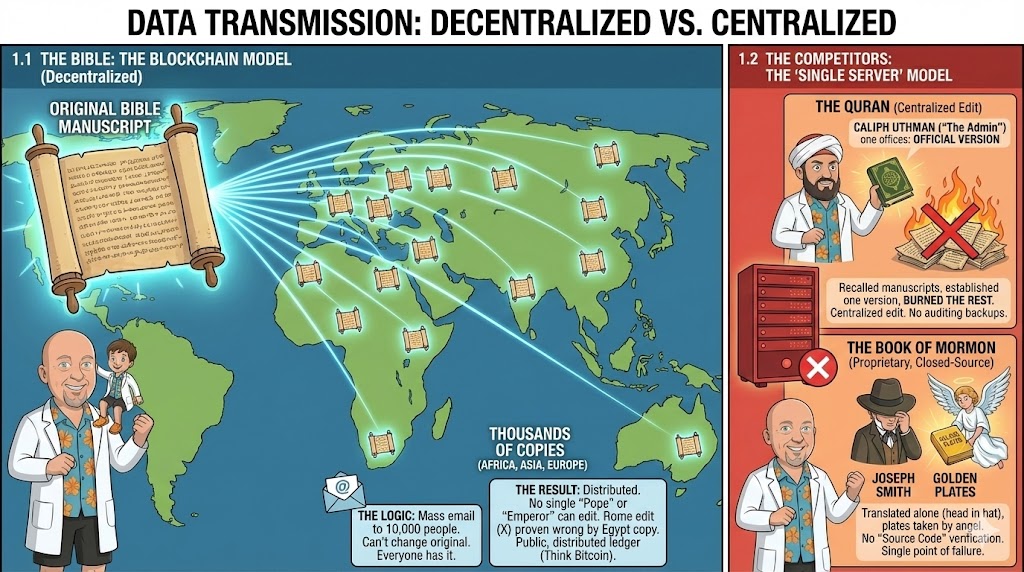
How do you prevent data corruption? You use a Decentralized Network.
1.1 The Bible: The Blockchain Model (Think Bitcoin)
The Bible was not written by one guy in a cave. It was written by 40 authors over 1,500 years. When the New Testament was written, thousands of copies were made immediately and sent to Africa, Asia, and Europe.
- The Logic: If I send a mass email to 10,000 people, and later I want to change the content of that email, I can't. Why? Because 10,000 people already have the original in their inbox.
- The Result: Because the Bible was spread out instantly (Decentralized), no single "Pope" or "Emperor" could gather them all up and edit them. If someone in Rome tried to change a verse, the copies in Egypt would prove him wrong. Just like Bitcoin, the ledger is public and distributed, making it impossible to hack without everyone noticing.
1.2 The Competitors: The "Single Server" Model
Compare this to other religious texts which rely on a Single Point of Failure.
- The Quran: Following the death of Muhammad, different versions of the Quran began to circulate. The Caliph Uthman (the "Admin") recalled all the manuscripts, established one "official" version, and burned the rest. This is a Centralized edit. We have no way of auditing the original data because the "backups" were destroyed by the state.
- The Book of Mormon: This text relies entirely on Joseph Smith. He claimed to find Golden Plates, translated them alone (often with his head in a hat), and then the plates were taken away by an angel. No one else could verify the "Source Code." It is a proprietary, closed-source system.
2.0 The Checksum: The Dead Sea Scrolls
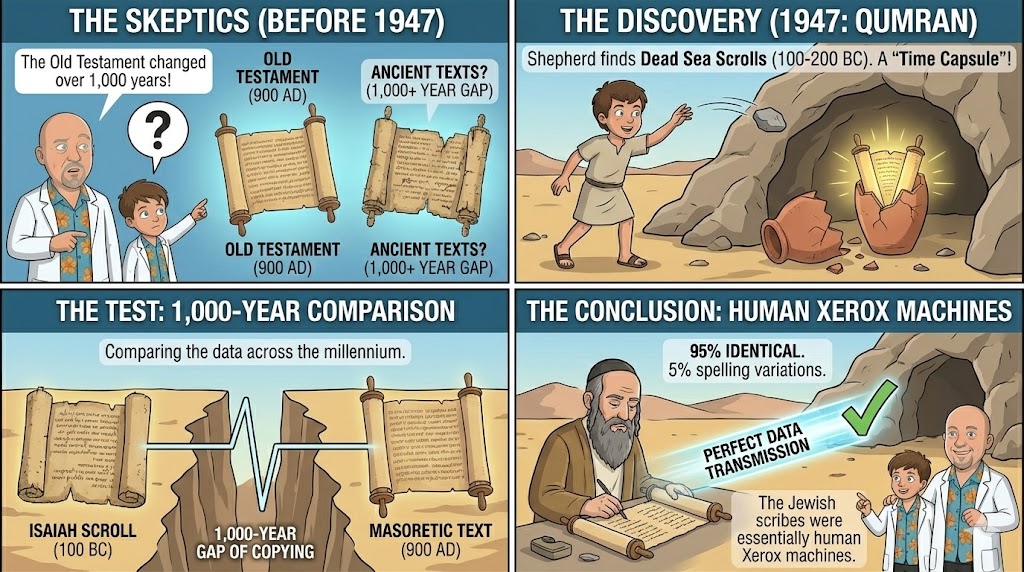
For centuries, skeptics said, "The Old Testament we have today was written in 900 AD. Surely it changed over the previous 1,000 years!"
Then came 1947. A shepherd threw a rock into a cave in Qumran and heard a jar break. Inside were the Dead Sea Scrolls—manuscripts dating back to 100-200 BC. This was a "Time Capsule" or a "Backup Tape" from a millennium earlier.
- The Test: Scholars compared the Isaiah Scroll (100 BC) with the Masoretic Text (900 AD). There was a 1,000-year gap of copying by hand.
- The Result: They were 95% identical. The 5% variations were essentially spelling differences (like "color" vs. "colour").
- The Conclusion: The Jewish scribes were essentially human Xerox machines. The data transmission was perfect.
3.0 The Latency Test: The Time Gap
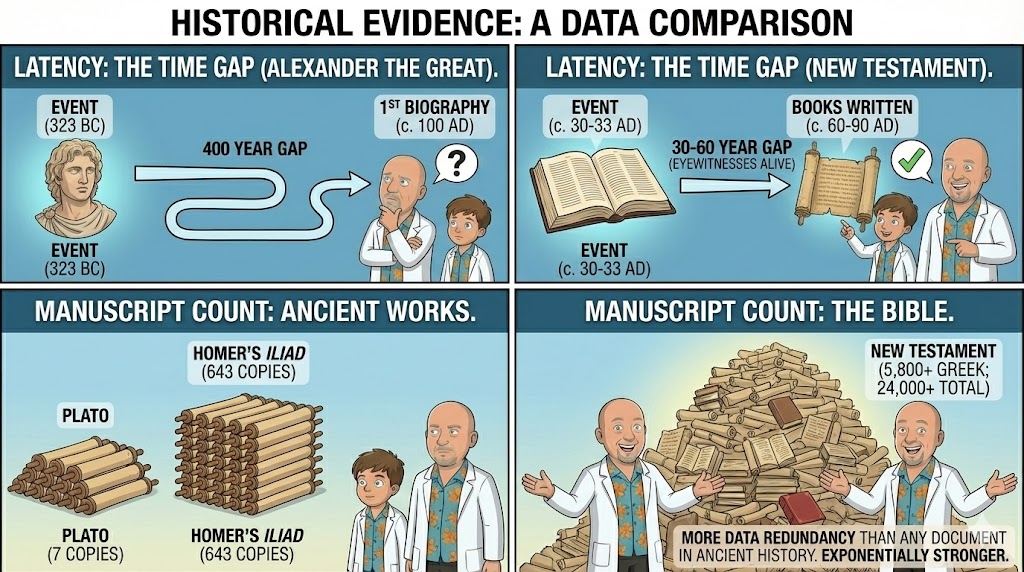
In history, "Latency" is the time gap between an event and the first written record of it. The shorter the gap, the more reliable the data.
- Alexander the Great: The earliest biography we have of him was written 400 years after he died. Yet, no one doubts his history.
- The New Testament: The books were written within 30-60 years of Jesus’ life, while eyewitnesses were still alive to fact-check them.
- The Manuscript Count:
- Plato: We have 7 ancient copies.
- Homer’s Iliad: We have 643 ancient copies.
- The New Testament: We have over 5,800 ancient Greek manuscripts (and 24,000+ if you count Latin and other translations).
The Bible has more data redundancy than any other document in ancient history. If you throw out the Bible, you have to throw out Plato, Aristotle, and Caesar, because the Bible’s evidence is exponentially stronger.
4.0 The Reality Check: Geography and Archaeology
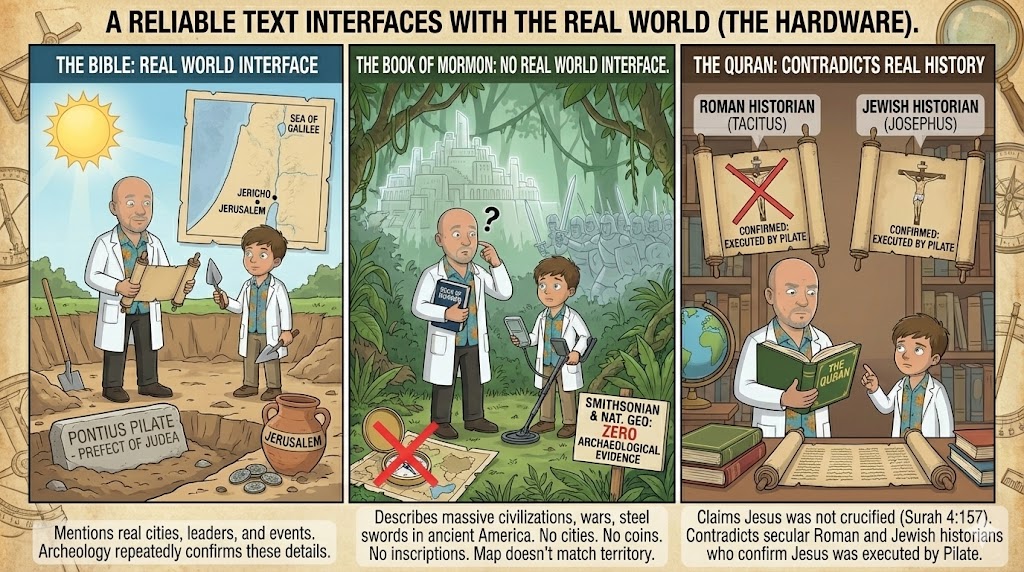
A reliable text must interface with the real world (The Hardware).
- The Bible: It mentions real cities (Jericho, Jerusalem), real leaders (Pontius Pilate, Caiaphas), and real events. Archeology repeatedly confirms these details.
- The Book of Mormon: It describes massive civilizations, wars with millions of casualties, and steel swords in ancient America. Yet, the Smithsonian and National Geographic have stated there is zero archaeological evidence to support these claims. No cities. No coins. No inscriptions. The map doesn't match the territory.
- The Quran: The Quran claims Jesus was not crucified (Surah 4:157). This contradicts not just the Bible, but secular Roman and Jewish historians (Tacitus, Josephus) who confirm Jesus was executed by Pilate.
4.1 Hardware Specs: Verified Artifacts
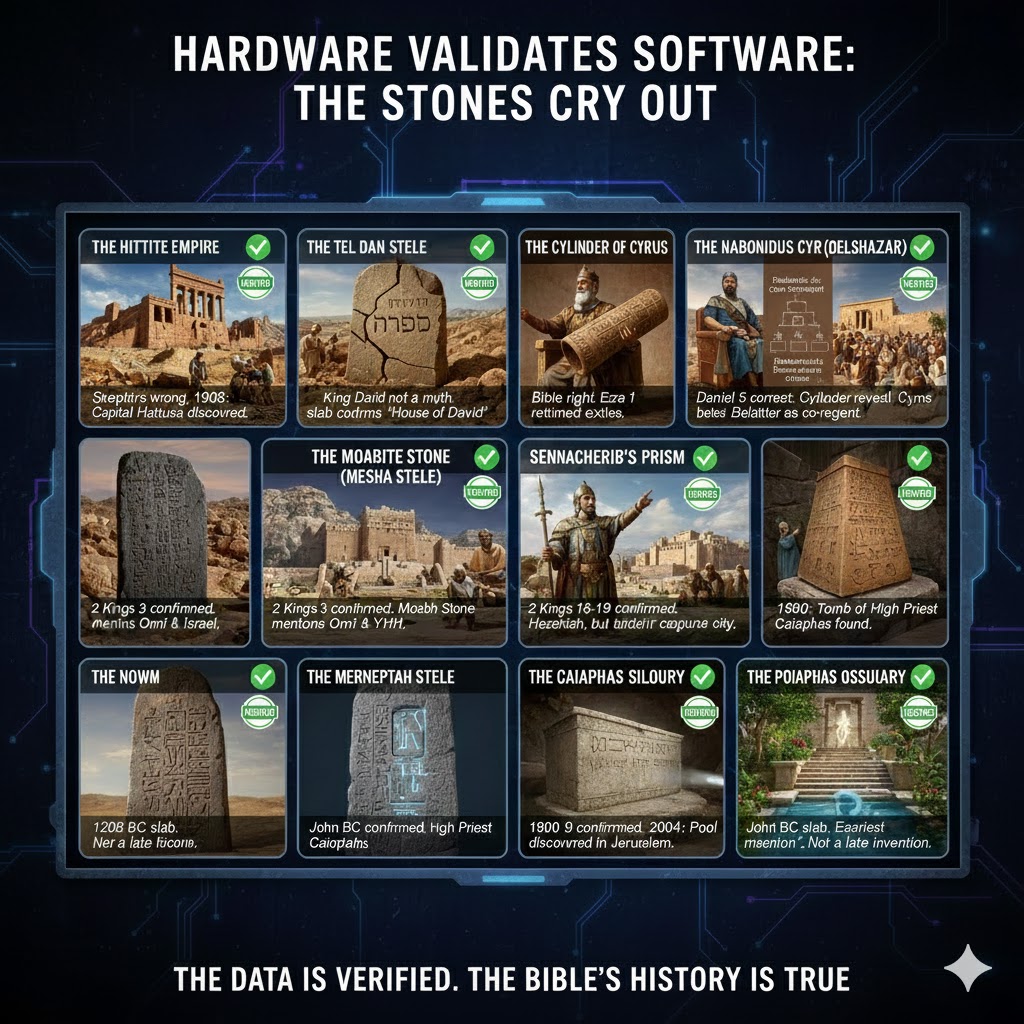
When we dig in the dirt, the "Hardware" validates the "Software." Here is a server rack of verified artifacts where the stones literally cried out:
- The Hittite Empire: For centuries, skeptics said the Bible was wrong because there was no record of "Hittites." Then in 1906, archaeologists discovered their massive capital, Hattusa, in modern Turkey. The Bible was right; the historians were wrong. Status: Verified.
- The Tel Dan Stele (House of David): Minimalists claimed King David was a myth—a Jewish "King Arthur." Then in 1993, a stone slab was found in Northern Israel containing a clear reference to the "House of David" from the 9th century BC. Status: Verified.
- The Cylinder of Cyrus: The Bible (Ezra 1) claims King Cyrus of Persia allowed Jewish exiles to return home to rebuild their temple. Skeptics doubted this benevolence until this clay cylinder was found, detailing Cyrus's specific policy of returning captive peoples to their homelands. Status: Verified.
- The Nabonidus Cylinder (Belshazzar): Critics mocked the book of Daniel for calling Belshazzar the last king of Babylon, as history books listed Nabonidus. This cylinder revealed that Belshazzar was Nabonidus's son and co-regent who ruled while his father was away—exactly why Belshazzar offered Daniel the "third" highest ruler position, not the second. Status: Verified.
- The Moabite Stone (Mesha Stele): This 9th-century BC stone tablet confirms the biblical account in 2 Kings 3 of the revolt of King Mesha of Moab against Israel. It mentions "Omri, King of Israel" and even contains the name of God, "YHWH". Status: Verified.
- Sennacherib’s Prism: This Assyrian clay prism details the siege of Jerusalem described in 2 Kings 18-19. King Sennacherib boasts, "As for Hezekiah the Judean... I shut him up like a caged bird in his royal city of Jerusalem." He admits he trapped him but—just as the Bible says—never claims to have captured the city. Status: Verified.
- The Caiaphas Ossuary: In 1990, workers uncovered a limestone bone box (ossuary) in Jerusalem. It was inscribed with the name of the High Priest who presided over the trial of Jesus: "Joseph son of Caiaphas." We have the physical family tomb of the man who condemned Christ. Status: Verified.
- The Pool of Siloam: In John 9, Jesus heals a blind man at the Pool of Siloam. Critics argued John was writing a metaphor because no such pool existed. In 2004, workers repairing a sewer line in Jerusalem uncovered the exact steps and pool John described, precisely where the Bible placed it. Status: Verified.
- The Merneptah Stele: This Egyptian stone slab from 1208 BC contains the earliest mention of "Israel" as a people group outside the Bible. It proves Israel was already established in Canaan over 3,200 years ago, crushing the theory that they were a late invention. Status: Verified.
5.0 Internal Consistency: The Hyperlink Structure
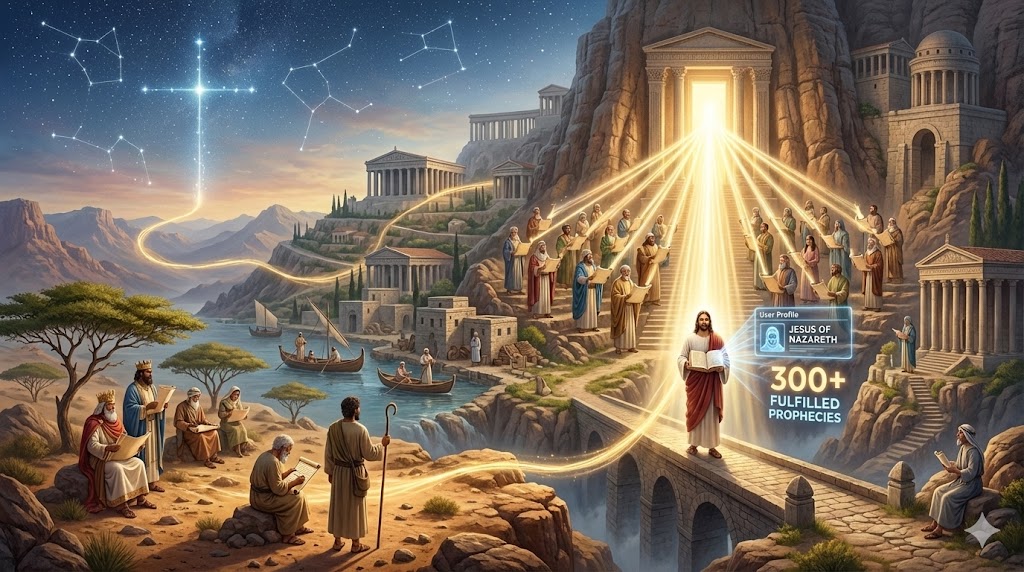
The Bible is not a book; it is a library. It contains 66 books, written by 40 different authors (kings, fishermen, doctors, shepherds) over 1,500 years, on three continents, in three languages.
- The Miracle: Despite this diversity, it tells one single, coherent story—the redemption of humanity through the Messiah.
- The Prophecy: The Old Testament contains over 300 specific predictions (hyperlinks) about the Messiah that were fulfilled perfectly in the User Profile of Jesus of Nazareth. The statistical probability of this happening by accident is mathematically zero.
6.0 Conclusion: The File is Verified
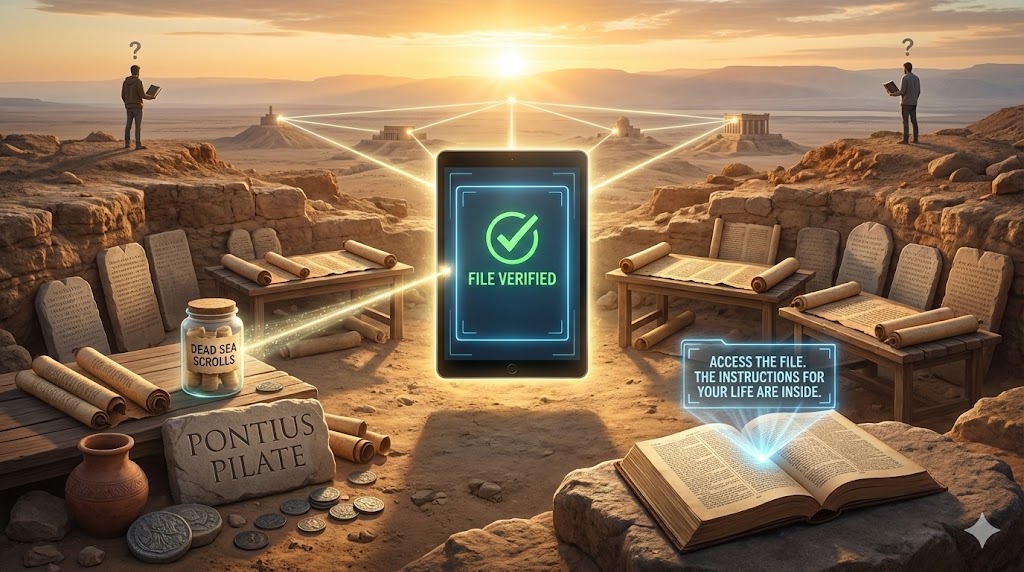
We have audited the Source Code.
- Transmission: Decentralized and unhackable.
- Integrity: Verified by the Dead Sea Scrolls.
- Latency: Written by eyewitnesses.
- Consistency: 1,500 years of agreement.
- Hardware: Validated by Archeology.
The other systems (Quran, Mormonism) rely on a single man’s unverifiable claim. The Bible relies on public events, public execution, and public resurrection, verified by thousands of witnesses and backed up by thousands of manuscripts.
The document is trustworthy. The question is... have you read it?
Access the file. The instructions for your life are inside.