
PREFACE: THE ANALYST'S NOTE
To the "Calendar Crusaders," the Skeptics, and the Believers caught in the middle:
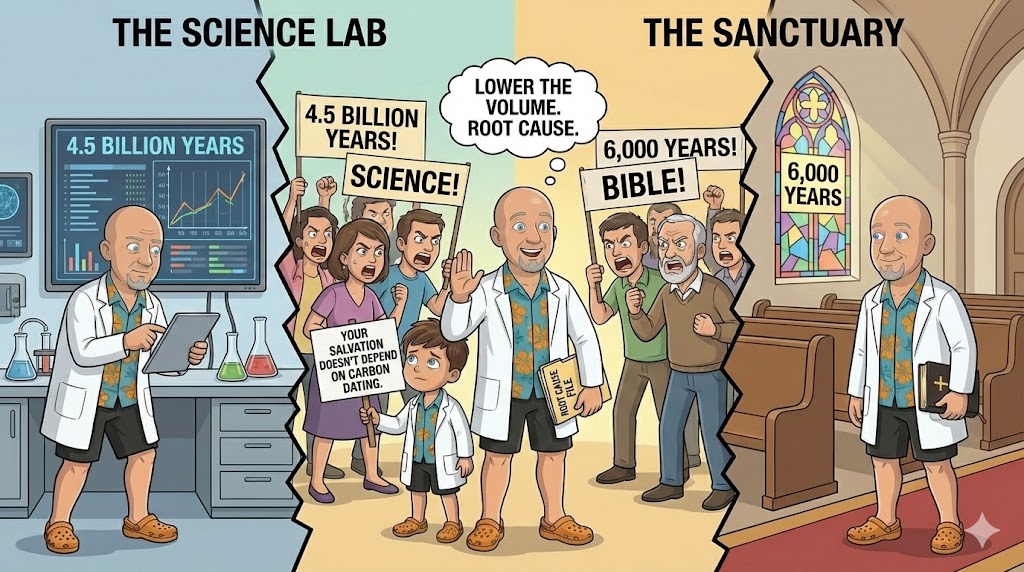
I’m writing this because the Church is currently having a massive family argument. If you go online, you’ll see Christians tearing each other apart over one question: How old is the Earth? One side says it’s 6,000 years old; the other says it’s 4.5 billion years old.
As a guy with a PhD who loves Jesus, I stand with one foot in the science lab and one foot in the sanctuary. And I’ll tell you straight: We need to lower the volume on this debate.
In my line of work, we look for the "Root Cause" of a problem. In this file, I’m not here to tell you which calendar is right. I’m here to show you that both sides have strong evidence, both sides love the Bible, and most importantly—your salvation doesn't depend on carbon dating.
Let’s take an honest look at the evidence without the anger.
1.0 The Fear Factor: Why Are We Fighting?
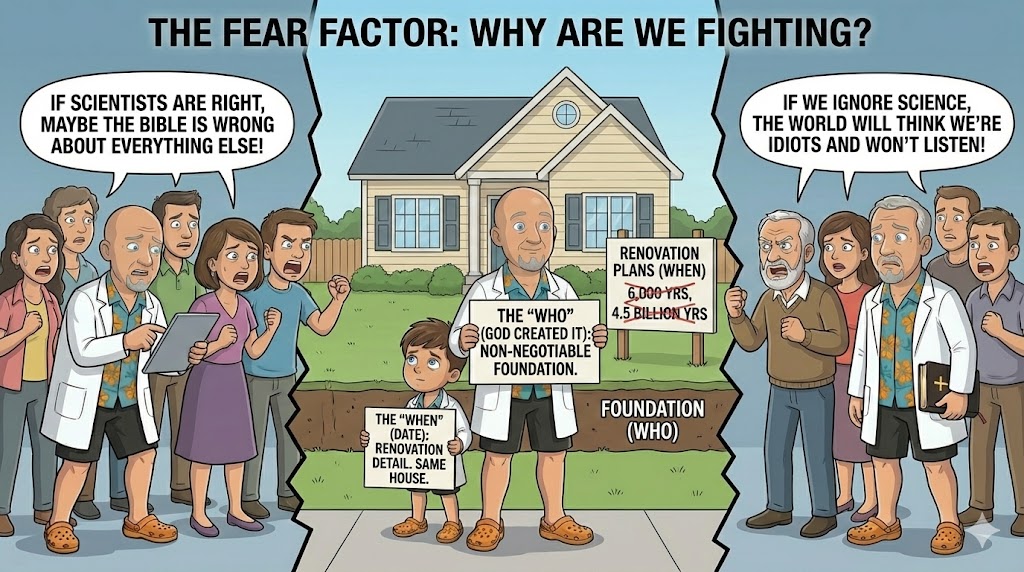
Why does this topic get people so heated? It’s usually about fear.
- The Fear on One Side: "If the scientists are right about the age of the earth, maybe the Bible is wrong about everything else."
- The Fear on the Other Side: "If Christians ignore basic science, the world will think we are idiots and won't listen to the Gospel."
But here is the reality: The "Who" (God created it) is a non-negotiable foundation. The "When" (the date on the calendar) is a renovation detail. You can disagree on the renovation date and still live in the same house.
2.0 Viewpoint A: The Young Earth (The "Plain Reading")
2.1 The "Power" Argument
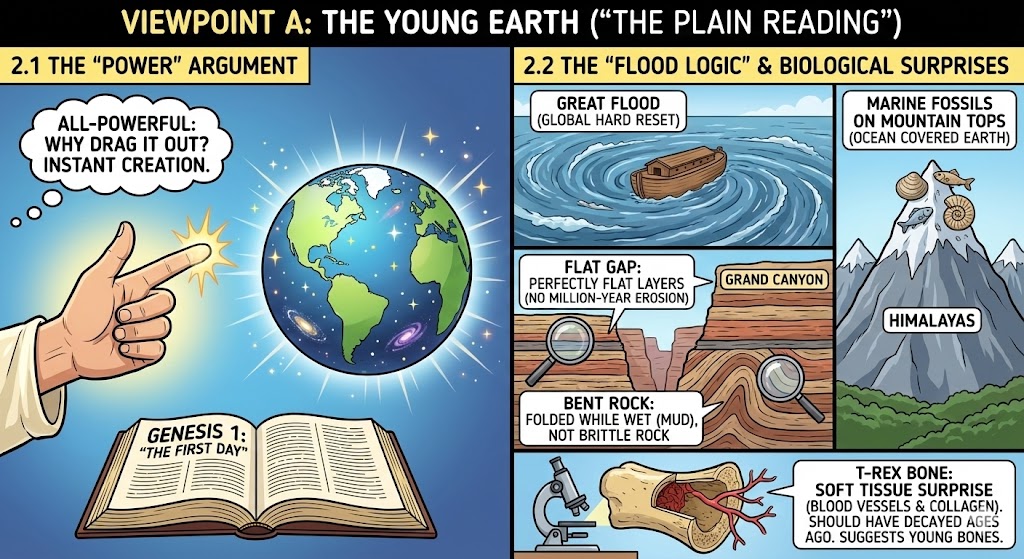
The Young Earth view takes the Bible exactly as it reads in English. When Genesis says "The First Day," they believe it means a literal 24-hour day, just like today.
- The Logic: God is all-powerful. He doesn't need 13 billion years to bake a cake. He can snap His fingers and create a fully functioning universe in an instant. Why would He drag it out?
2.2 The "Flood Logic" and Biological Surprises
The strongest scientific argument for this view comes from looking at catastrophe rather than slow time. They point to the Great Flood of Noah as a "Global Hard Reset" that rearranged the planet's surface in one year, not millions.
- The Grand Canyon Evidence: When you look at the Grand Canyon, you see massive layers of rock stacked like pancakes.
- The "Flat Gap": The layers are perfectly flat on top of each other. If these layers sat there for millions of years before the next one was added, wouldn't rain and wind have eroded them, creating uneven surfaces? The lack of erosion suggests they were laid down rapidly, one after another, by water.
- The "Bent Rock": In places like the Tapeats Sandstone, we see rock layers folded at 90-degree angles without cracking. Rock is brittle; if you bend it, it breaks. But if you bend wet mud, it folds. This suggests these layers were folded while they were still soft and wet during a massive flood event, then hardened later.
- Fish Out of Water: We find fossils of marine life (clams, fish, ammonites) on the tops of the highest mountains in the world, including the Himalayas.
- The Conclusion: How did sea creatures get to the top of Mount Everest? The Young Earth view says the ocean waters covered the earth (Genesis Flood) and then the mountains rose up rapidly as the waters receded.
- The Soft Tissue Surprise: Believe it or not, scientists have found soft tissue (like blood vessels and collagen) inside T-Rex bones.
- The Conclusion: Biological material decays very quickly. If those bones are truly 65 million years old, that tissue should have turned to dust ages ago. The fact that it is still elastic suggests those bones might be much younger than we think.
3.0 Viewpoint B: The Old Earth (The "Ancient Evidence")
3.1 The "Timeless God" Argument
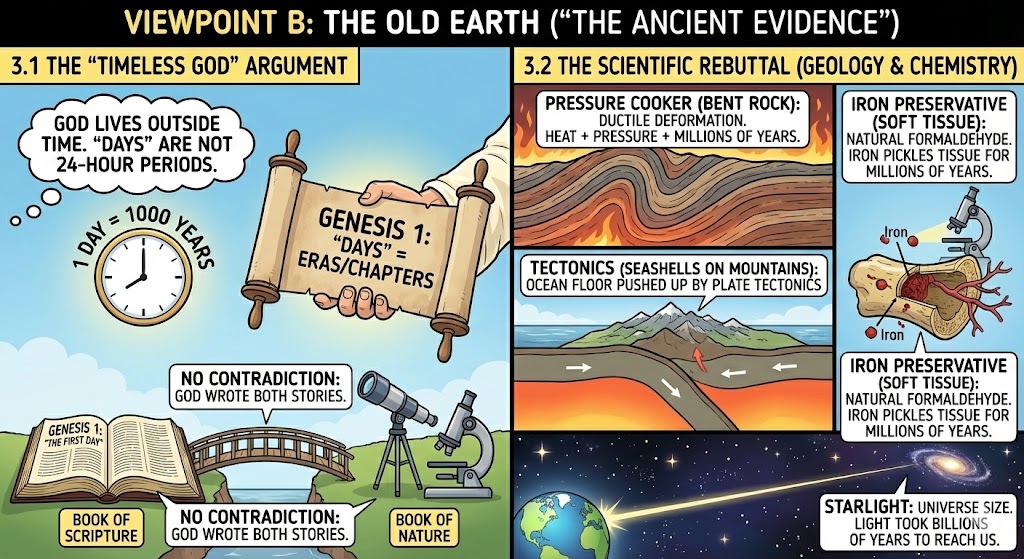
The Old Earth view looks at the Bible and says, "God lives outside of time." Scripture says, "To the Lord, a day is like a thousand years." They believe the "Days" in Genesis are eras or chapters of creation. God is the author of the "Book of Scripture" and the "Book of Nature"—He wouldn't write contradictory stories.
3.2 The Scientific Rebuttal (Geology & Chemistry)
The Old Earth view argues that what looks like a catastrophe might actually be the result of immense time, pressure, and chemistry.
- The "Pressure Cooker" Response: Regarding the bent rocks in the Grand Canyon—geologists argue that solid rock can bend without breaking if it is buried deep underground under immense heat and pressure (a process called ductile deformation). It doesn't have to be wet mud; it just needs millions of years of pressure.
- The Tectonics Response: Regarding the seashells on mountains—Old Earth science points to Plate Tectonics. The tops of those mountains used to be the ocean floor. Over millions of years, the continental plates crashed into each other, buckling the earth and pushing the old seafloor up into the sky.
- The "Iron Preservative" Response: Regarding the dinosaur soft tissue—Old Earth scientists argue that iron within the dinosaur's blood acted like a natural formaldehyde. Under specific conditions, this iron can "cross-link" proteins, essentially pickling the tissue and preserving it for millions of years, much longer than normal decay allows.
- The Starlight: We see galaxies billions of light-years away. If the universe is young, that light shouldn't be here yet. The sheer size of the universe screams "Ancient."
4.0 The Third Option: The "Ready-to-Use" Universe
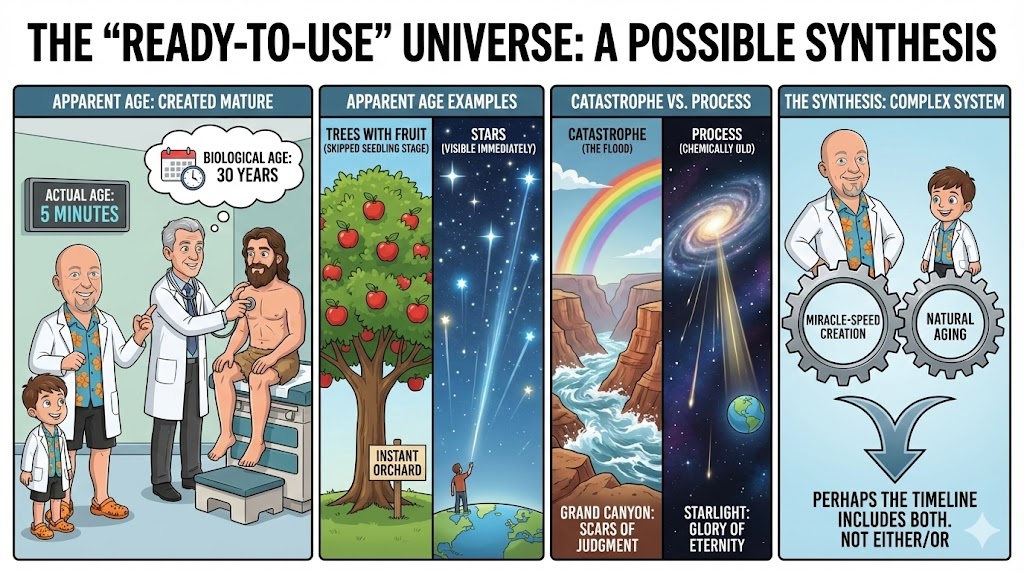
Here is a question that might solve the tension: When God created the first man, Adam, did he look like a baby or a grown man?
Most would say he was created as a fully grown man. If a doctor had examined Adam five minutes after he was created, the doctor would say, "This man is 30 years old." His biological age (how old he looks) would be 30, but his actual age (time since creation) would be five minutes.
- Apparent Age: God creates things "ready to use." He made trees with fruit already on them (skipping the seedling stage). He made stars so we could see them.
- Catastrophe vs. Process: It’s possible we are seeing both. The earth might be chemically old (process) but was reshaped by a recent catastrophic event (The Flood).
- The Synthesis: The Grand Canyon might show us the scars of judgment (The Flood), while the starlight shows us the glory of eternity. Perhaps the timeline isn't "Either/Or"—maybe it's a complex system that includes both miracle-speed creation and natural aging.
5.0 The Bottom Line: Don't Miss the Point
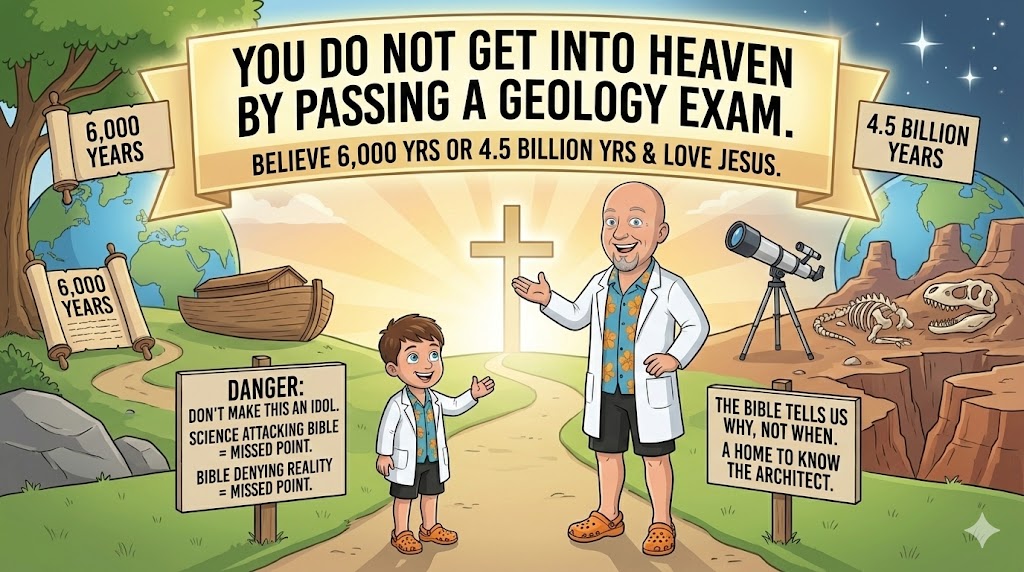
This is the "Big and Bold" truth I need you to hear: You do not get into Heaven by passing a Geology exam.
You can believe the earth is 6,000 years old and love Jesus. You can believe the earth is 4.5 billion years old and love Jesus.
The danger comes when we make this issue an idol. If you are using science to attack the Bible, you’ve missed the point. If you are using the Bible to deny reality, you’ve missed the point.
The Bible isn't trying to tell us when the earth was made; it's telling us why it was made. It was made as a home for us to know the Architect.
6.0 Conclusion: The Main Thing
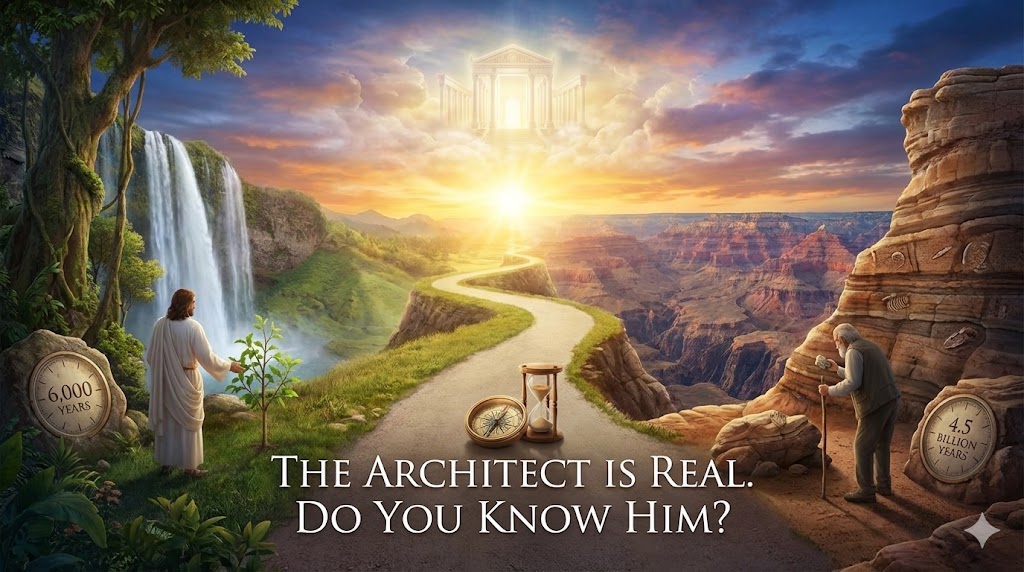
The evidence for both sides is compelling. The debate is fascinating. But don't let the timeline distract you from the lifeline.
The most important "time" isn't the age of the rocks; it's the moment you decide to stop running your life on your own and let the Creator take over. Whether we have been here for a blink of an eye or eons of ages, the call is the same.
The Architect is real. Do you know Him?