PREFACE: THE ANALYST'S NOTE
To the Children of Israel, the People of the Book, and my own flesh and blood:
I write this file as a son of the tribe. I am Ashkenazi, born of the seed of Abraham, Isaac, and Jacob. While I was not raised in a strictly observant religious household, the traditions and rhythm of our people—the logic of the Talmud and the melody of the Kol Nidre—were the essential background of my life and family gatherings. I love the Torah; it is the most robust, ethical source code ever downloaded to humanity.
However, as an analyst, I look at the world through the lens of systems architecture. Many of us treat our Jewish identity as a legacy application—it is cultural, it is comfortable, and we often run it in the background without ever checking the source code. But in tech, a blind assumption is a "Fatal Error" waiting to happen. If you are running a 2,000-year-old emulation of a system that originally required physical hardware, it is time for a code audit.
"I will give you a new heart and put a new spirit in you; I will remove from you your heart of stone and give you a heart of flesh." (Ezekiel 36:26)
1.0 Executive Summary: The Hardware Failure
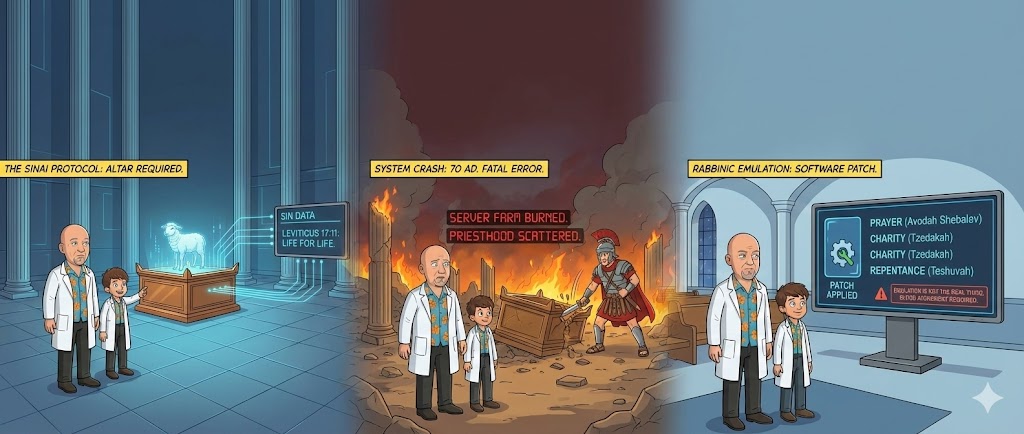
The Sinai Protocol was designed to run on specific hardware: The Temple and The Priesthood. It required a physical Altar to process "Sin Data". The original specs were clear: sin causes System Corruption (Death), and to fix it, a life must be exchanged for a life. As documented in Leviticus 17:11: "For the life of a creature is in the blood, and I have given it to you to make atonement for yourselves on the altar".
The System Crash (70 AD): In 70 AD, the Romans burned the "Server Farm"—the Second Temple. The Altar was smashed and the Priesthood scattered. This created a catastrophic "Fatal Error". We are now legally obligated by the Torah to run a program that requires hardware we no longer possess.
The Rabbinic Emulation: Faced with this error, the Council of Jamnia wrote a Software Patch. They declared that Prayer (Avodah Shebalev), Charity (Tzedakah), and Repentance (Teshuvah) would replace the Sacrifice. But nowhere in the Torah did God rescind the requirement for blood atonement. Emulation is not the same as the Real Thing.
2.0 The Kernel Architecture: Promises vs. Contracts
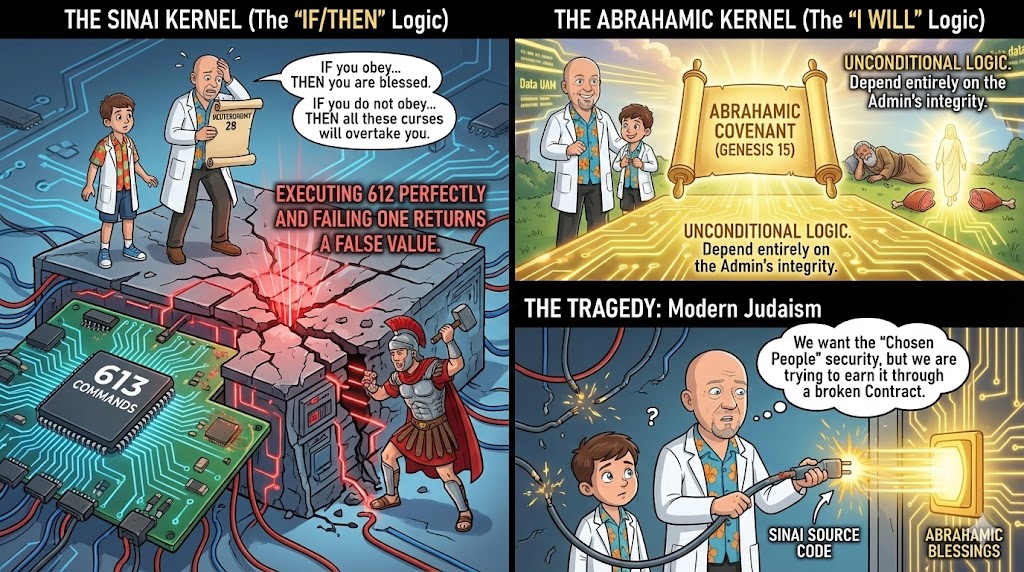
Every developer knows the difference between a Promise (Giver-dependent) and a Contract (User-performance-dependent).
2.1 The Sinai Kernel (The "IF/THEN" Logic)
The Sinai Torah is built on strict Conditional Logic (Deuteronomy 28): IF you obey... THEN you are blessed. IF you do not obey... THEN all these curses will overtake you. In a codebase of 613 commands, executing 612 perfectly and failing one returns a FALSE value.
2.2 The Abrahamic Kernel (The "I WILL" Logic)
Before Sinai, there was an older Kernel: The Abrahamic Covenant. When God made this deal, He put Abraham to sleep and walked through the sacrifice alone. This was Unconditional Logic. It depended entirely on the Admin's integrity.
The Tragedy: Modern Judaism tries to access the Abrahamic Blessings using the Sinai Source Code. We want the "Chosen People" security, but we are trying to earn it through a broken Contract.
3.0 The Logic Engine: Hard Currency vs. Fiat Currency
3.1 The Blood Standard (Hard Currency)
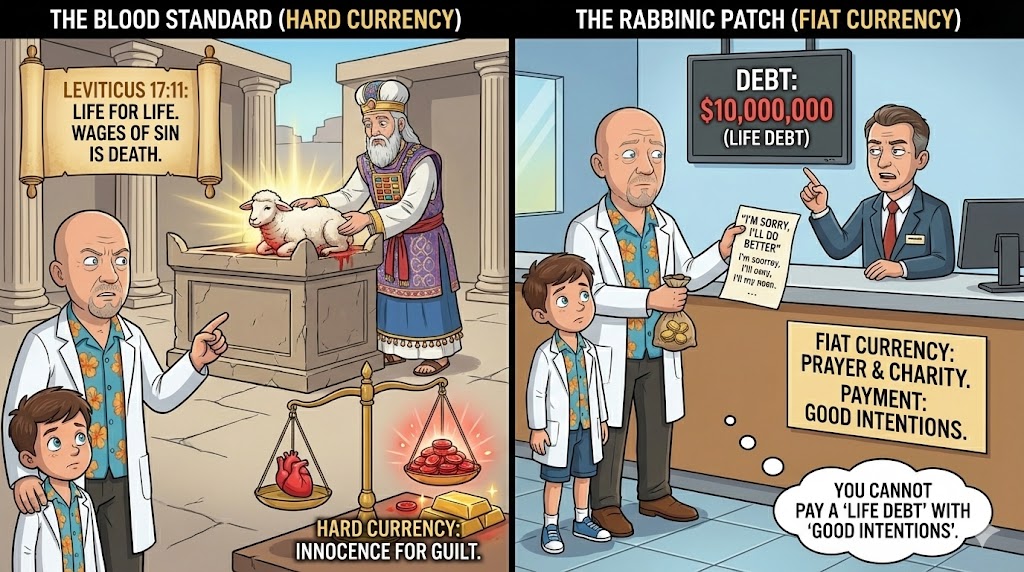
In the original protocol, the "wages of sin is death". The central algorithm (Leviticus 17:11) is clear: "It is the blood that makes atonement for one's life". On Yom Kippur, the High Priest offered Hard Currency—a life for a life. Innocence died so Guilt could live.
3.2 The Rabbinic Patch (Fiat Currency)
When the Temple was destroyed, the Rabbis introduced Fiat Currency: Prayer and Charity. But imagine you owe a $10 million mortgage. Original Protocol: You pay in Gold (Blood). New Protocol: You write a poem about how sorry you are (Prayer). The bank manager might appreciate the sentiment, but the debt remains. You cannot pay a "Life Debt" with "Good Intentions".
4.0 The Connection Timeout: A 2,000-Year Glitch
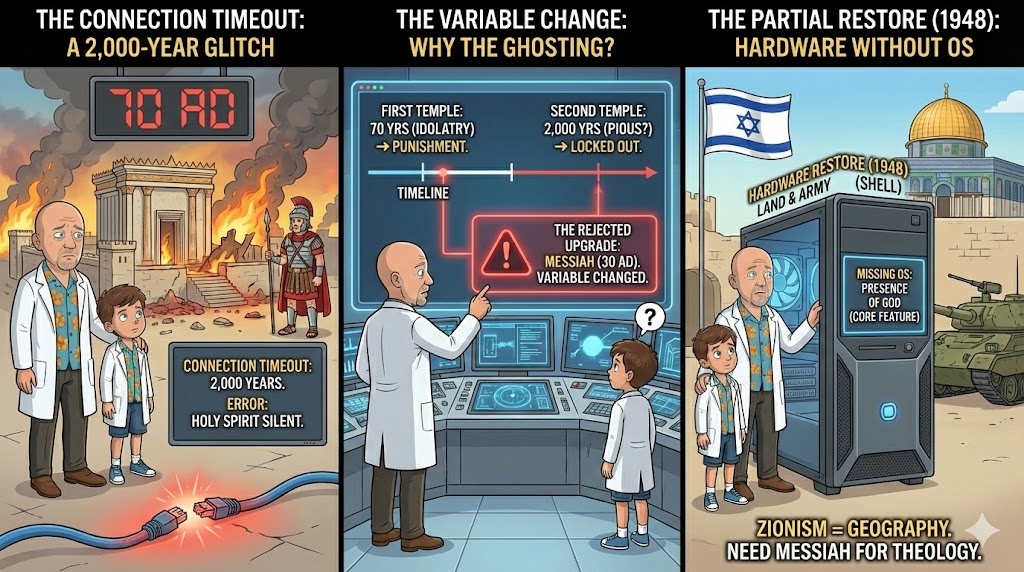
In computer networking, if a client tries to connect and gets no response, it triggers a Timeout Error. The Babylonian Exile lasted exactly 70 years, as predicted. We did the time, and the connection was restored. But the Roman Exile began in 70 AD and has never spiritually ended. The Temple is still gone, and the Holy Spirit is silent in our synagogues.
The Variable Change: Why has the Admin ghosted us for 2,000 years? In the First Temple era, we worshiped idols and were punished for 70 years. In the Second Temple era, we were pious, yet we have been locked out for 2,000 years? As a systems analyst, I look for the variable that changed. 40 years before the Temple fell, we rejected the Upgrade—the Messiah.
The Partial Restore (1948): I view the State of Israel as a Hardware Restore without the OS. We have the Land and the Army (the shell), but the core feature—the Presence of God—is missing. Zionism returned us to the geography, but only the Messiah returns us to the Theology.
5.0 The Two-Login Solution
Why did our ancestors reject Him? Because they saw two contradictory data streams in the prophets: Stream A (Suffering Servant) and Stream B (Conquering King). They were desperate for the "Conquering King," so they rejected the "Suffering Servant" who came to kill our sin. But the database was describing **Two Distinct Logins** for one Messiah: First to deal with the internal virus (Sin), and Second to deal with the external virus (Evil).
6.0 Conclusion: Grip vs. Harness
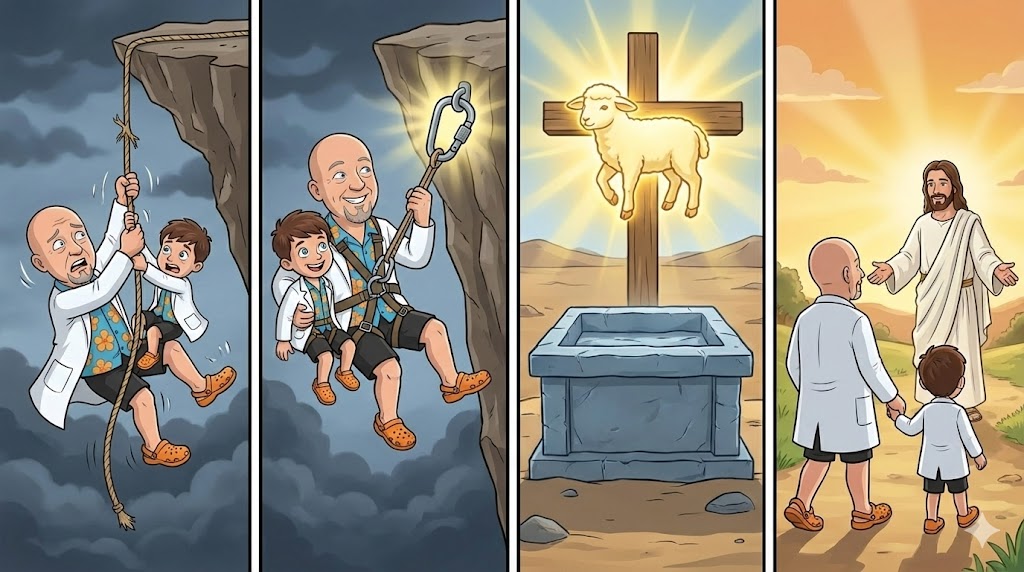
The Exit Protocol: Rabbinic Judaism relies on Grip Strength—hanging off a cliff by a rope. As long as you are strong and "good enough," you are safe. But if your hand slips for a second—if you die in fear, pain, or confusion—you fall. The Messiah is a Carabiner. When you trust Christ, you are clipped into a safety harness. You do not fall because the logic depends on the strength of the Anchor, not the climber.
My brothers, the Altar is cold, but the Final Sacrifice has already been offered. The Passover Lamb has been slain. The System didn't crash—it was Fulfilled. Come home to the Messiah.