




QTM 102What do the Muslims Really Believe?
What Do Muslims Believe?
To the reader:
What do Muslims believe? When many Westerners hear "Islam," we think of one thing: the news.
We think of anger. We think of conflict. We think of extremists.
That picture is wrong.
If you actually sit down with a devout Muslim, you often find discipline. You find a deep respect for God. You find hospitality. You find people who are trying to please the Creator by following the rules.
But here is the question we need to ask: Are the rules the problem?
I am not focused on politics. I care about what each faith actually teaches. Islam claims to be the final, corrected form of the Abrahamic faith. It claims to fix what Judaism and Christianity got wrong.
So I looked at the history, the claims about Jesus, and how salvation is said to work.
And I found a serious problem with the timeline.
"Come now, let us reason together."
(Isaiah 1:18)
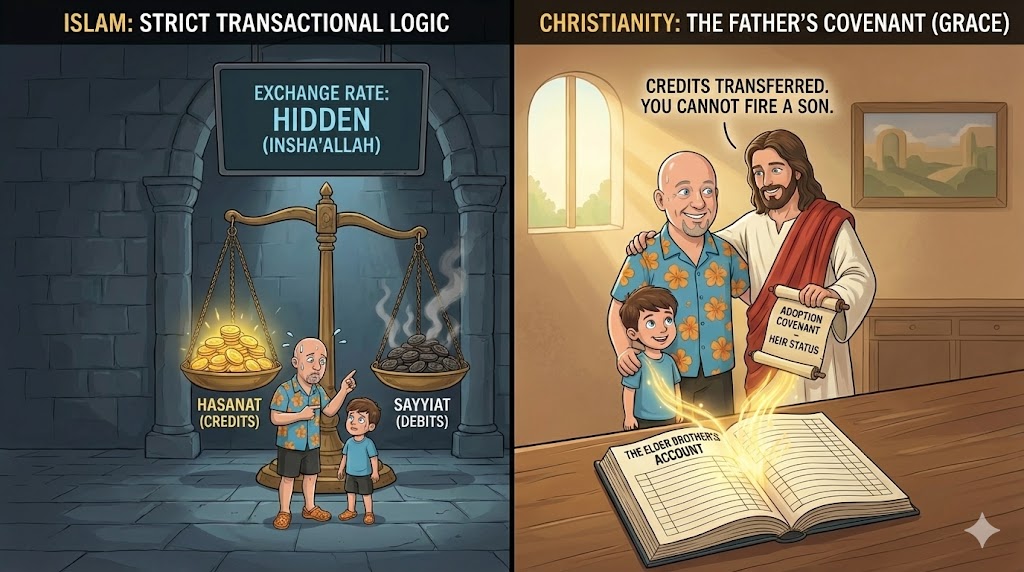
1. Submission vs. Adoption
The word Islam means "Submission."
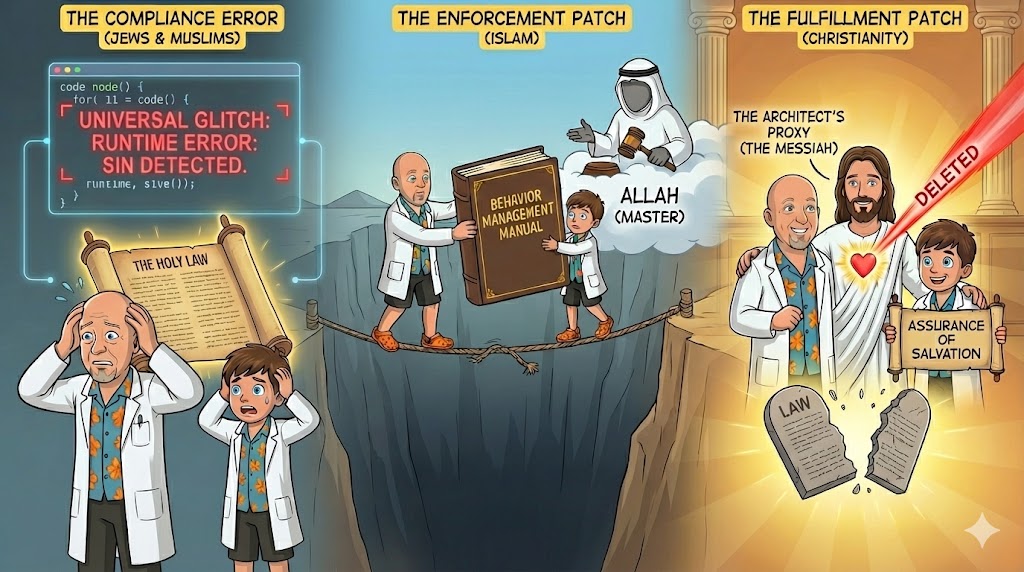
The faith is built on the idea of Master and Servant. God (Allah) is the Master; you are the servant.
To keep your standing, you must do five specific duties known as the Five Pillars. These are not suggestions; they are requirements.
1.1 The Five Pillars
- Shahada (The Oath): The confession of faith: "There is no god but Allah, and Muhammad is his messenger."
- Salat (The Schedule): Praying five times a day, facing Mecca, at specific times.
- Zakat (The Offering): A mandatory giving (2.5% of your wealth) to the poor.
- Sawm (The Discipline): Fasting from food and water from sunrise to sunset during the month of Ramadan.
- Hajj (The Journey): A once-in-a-lifetime pilgrimage to Mecca to perform specific rituals.
The idea:
This is like a job. You do the work, and you hope to get the reward. But notice the direction: you reaching up to God. It is people trying to reach God by following a ladder of rules.
1.2 The Christian View: Adoption
Christianity works differently. It is like a gift, not a wage.
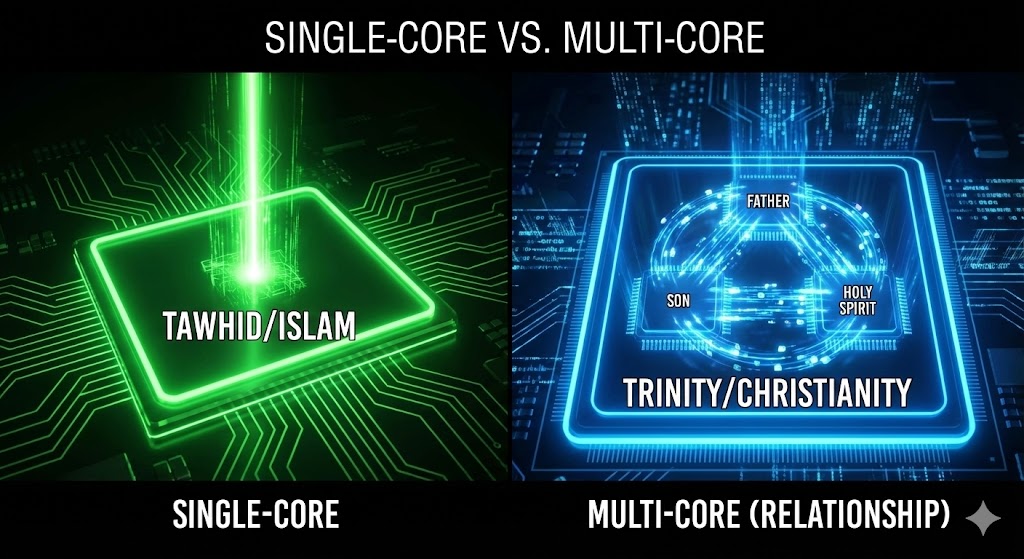
The Bible describes a relationship not of Master and Servant, but of Father and Son.
Think of it this way:
- An employee is valued by how well he performs. He has to meet his goals. If he stops working, he can lose his job.
- A son is valued because he belongs to the family. He does not have to "earn" his name. Even when he fails, he is still part of the family.
Islam offers you a contract. Christianity offers you adoption into a family.
The difference is not just words; it is security. You can be fired from a job; you cannot be fired from a family.
2. Jesus in Islam
Many Westerners think Islam downplays Jesus. The opposite is true. Islam honors Him greatly—but then places a limit on who He is.
In the Quran, Jesus (Isa al-Masih) is not just a teacher. He is given amazing power. In fact, what Islam says about Jesus gives Him a higher place than Muhammad in many ways.
2.1 The Miracles
The Quran attributes miracles to Jesus that are staggering. He isn't just delivering a message; He is altering the laws of nature.
- He spoke as a baby: While still in the cradle, He spoke in full sentences to defend His mother's honor (Quran 19:29-33).
- He cured the incurable: He healed the blind and the lepers (Quran 3:49).
- He raised the dead: He brought dead people back to life by Allah's permission (Quran 3:49).
- He created life: This is the big one. The Quran says Jesus formed a bird out of clay, breathed into it, and it became a real, living bird (Quran 3:49).
Here is the point:
In both Islam and Christianity, creating life is something only God does. Prophets deliver a message; they do not create life.
By saying Jesus could breathe life into clay, Islam is saying He had the power of a Creator.
2.2 The Second Coming
Here is the plot twist most Christians don't know: Muslims are waiting for the return of Jesus, too.
In Islamic theology, it is not Muhammad who returns to save the world in the End Times. It is Jesus.
They believe Jesus is currently alive in Heaven (since He didn't die on the cross). In the last days, He will descend physically to Damascus to defeat the Al-Masih ad-Dajjal (The Antichrist).
But here is the catch:
They believe He is coming back to "correct" the Christians. The Hadith teaches that He will break the crosses, kill the swine, and tell the world, "I never said I was God" (Sahih al-Bukhari 2476).
2.3 Who Is Really on Top?
This is where things get puzzling. If you set aside the names and just look at what the Quran says about each man, the order does not add up.
According to Islam:
- Muhammad: Born normally. Sinned and was told to ask for forgiveness (Quran 40:55). Died in Medina. Is in a grave waiting for the Day of Judgment.
- Jesus: Born of a virgin. Lived a sinless life (Quran 19:19). Performed miracles. Did not die but was taken up to Heaven (Quran 4:158). Is with God now and will return to judge the world.
So what does that mean?
Islam says Muhammad is the greatest prophet. But what the Quran says about Jesus sounds more like what you would say about God.
3. The Cross: What Really Happened?
This is the biggest disagreement between the two faiths.
- History says: Jesus of Nazareth died on a Roman cross and was buried.
- The Quran says: It looked like Him, but it wasn't Him.
The Claim:
Surah 4:157 states: "They did not kill him, nor did they crucify him, but it was made to appear to them so."
The standard Islamic interpretation is the "Substitution Theory"—that Allah miraculously switched Jesus's face with someone else (perhaps Judas) moments before the arrest.
3.1 What Other Sources Say
First, we need to be sure a crucifixion actually happened. We do not only have the Bible; we have other sources—including people who were not Christians.
- Cornelius Tacitus (Roman Historian, 116 AD): He confirms that "Christus" suffered the "extreme penalty" (crucifixion) during the reign of Tiberius at the hands of Pontius Pilate (Annals 15.44).
- Flavius Josephus (Jewish Historian, 93 AD): A non-Christian Jew who records that Pilate "condemned him to the cross" (Antiquities 18.3).
- The Jewish Talmud: It records that "Yeshu" was "hanged" (a euphemism for crucifixion) on the eve of the Passover because he practiced sorcery (Sanhedrin 43a).
So:
Romans, Jews, and Christians all say Jesus was crucified. The only book that says otherwise was written 600 years later, far away.
3.2 What About His Mother?
The Quran says the person on the cross was someone else. But that overlooks the most important witness there: His mother.
The Gospel says Mary stood at the foot of the cross (John 19:25).
- Think about it: A mother knows her son. His face, his voice, his eyes.
- That means: If God switched Jesus with Judas, He did not only fool the Romans; He fooled Mary.
That raises a hard question. If the substitution theory is true, then God did a miracle so that a faithful mother would believe she was watching her own son be tortured to death. She grieved over a lie.
We have to ask: Does that kind of deception fit with the "God of Truth"?
3.3 The Empty Tomb
Did anyone see Him afterward?
While we don't have a Roman letter saying "I saw a ghost," we have a massive piece of data from the enemy side: The Missing Body.
When the disciples started claiming Jesus was alive, the Jewish authorities didn't say, "No, he's in the grave, here is the body." Instead, they claimed the disciples stole the body (Matthew 28:11-15).
That is the key point:
By saying the body was stolen, Jesus's enemies were admitting the tomb was empty.
If the man on the cross was an imposter (Judas), his body would still be in the tomb. The Romans or Jews could have simply rolled out the corpse of the "Imposter" to prove the resurrection was a lie. They didn't. They couldn't. Because the tomb was empty.
What the early church said:
Within a few years of the event, the early church had a creed (1 Corinthians 15:3-6) that said Jesus appeared to:
- Peter
- The Twelve
- 500 brothers at one time
- James (His skeptic brother)
- Paul (His enemy)
People may hallucinate alone; they do not all see the same thing in groups of 500. And skeptics like James and Paul do not die for a hallucination. They died because they were convinced they had seen Jesus alive.
4. Has the Bible Been Changed?
When you show a Muslim friend Bible verses where Jesus claims to be God, they often say: "The Bible has been corrupted." (This is the doctrine of Tahrif).
The claim is that the original Gospel (Injeel) matched Islam and said Jesus was only a man, but Christians later changed the text to make Him God.
The problem:
If you say a document was changed, you have to answer: When did that happen?
4.1 Scenario A: Before Muhammad (Pre-600 AD)?
If the Bible was already corrupted before Islam began, then the Quran has a major internal contradiction.
- The Quran repeatedly confirms the Torah and the Gospel are from God.
- Surah 5:47 commands the Christians ("People of the Gospel") to "judge by what Allah has revealed therein."
- So: Why would God tell Christians to follow a book that was already full of lies? If it was corrupted, He would have warned them against it, not told them to use it.
4.2 Scenario B: The Timeline Problem (Post-600 AD)
If the theory is that Christians changed the Bible after Islam arrived to hide the truth about Jesus, we run into a massive practical problem.
By the 7th Century, the New Testament wasn't sitting in a single vault in Rome. It had already spread across the entire known world. There were thousands of copies circulating in Europe, Africa, and Asia. It was being read in Greek, Latin, Syriac, and Coptic.
What changing the text would have required:
Imagine trying to change the ending of a famous book that has already sold a million copies.
To do it, someone would have had to:
- Travel to every country and every church.
- Confiscate every single scroll (without anyone hiding one).
- Destroy them all.
- Write thousands of new, fake Bibles.
- Put them back on the shelves without history ever recording that a "Great Book Swap" took place.
It simply couldn't be done. The message had already left the building. The reason all our ancient manuscripts match is because nobody could ever gather them all up to change them.
4.3 The Dead Sea Scrolls
For centuries, skeptics had a fair question: "How do we know the Old Testament wasn't changed over a thousand years of copying?"
Then, in 1947, a shepherd threw a rock into a cave in Qumran and heard a jar break. Inside, he found what we now call the Dead Sea Scrolls.
These manuscripts dated back to 100-200 BC—hundreds of years before Jesus or Muhammad were even born. They had been sitting in a clay jar, untouched by human hands for two millennia.
The Great Isaiah Scroll (1QIsaᵃ):
The most famous find was a complete scroll of the Book of Isaiah. When scholars unrolled it, they could compare a copy from 100 BC with the Bible we use today.
What they found:
- About 95% the same: The text matched word for word.
- The small differences: Mostly spelling (like "color" vs. "colour") or copying mistakes. The message was unchanged.
The crucial point (Isaiah 53):
Isaiah 53 is the chapter that says the Messiah will be "pierced for our transgressions" and "crushed for our iniquities."
Some used to say Christians wrote this after Jesus died to make it look like prophecy.
But the Great Isaiah Scroll shows that Isaiah 53 was in that jar 100 years before Jesus was born.
So:
The text has not drifted. The Bible we have today is the same one the prophets wrote and the same one the Quran originally pointed to. The chain is unbroken.
5. The Scales vs. the Guarantee
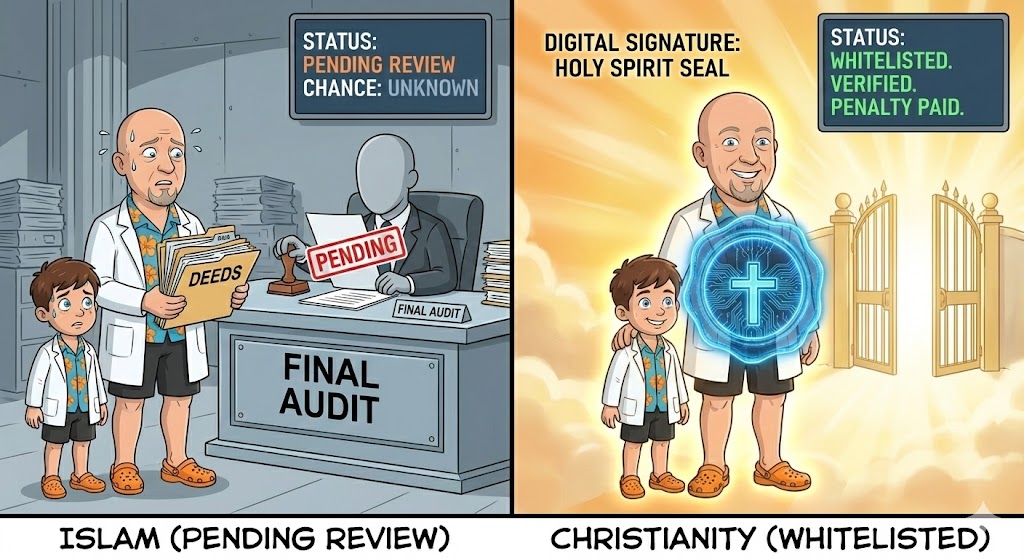
In the end, every faith is trying to answer one question: How do I stand before God on Judgment Day?
5.1 Islam: The Scales (Al-Mizan)
In Islam, your fate is like a balance sheet. On the Day of Judgment, your deeds are placed on a set of scales (Al-Mizan).
- On one side: Your prayers, fasting, and charity.
- On the other side: Your sins, anger, and failures.
The idea:
If the good outweighs the bad... you might get in.
But in the end, it depends on Allah's will. There is no guarantee.
Even Muhammad himself said, "No one of you will become entitled to Paradise by his good deeds alone... not even I, unless Allah wraps me in His mercy" (Sahih al-Bukhari 5673).
The Risk:
This creates a system of Uncertainty. You can pray five times a day, fast every Ramadan, and give to the poor... and still stand at the grave wondering, "Did I do enough?"
5.2 Christianity: The Substitute
Christianity takes a different view of the math. It admits that if you put your deeds on the scale, the "Bad" side will hit the floor every time. The standard is perfection, and none of us are perfect.
But instead of asking you to add more to the "good" side, Jesus steps onto the scale for you.
The difference:
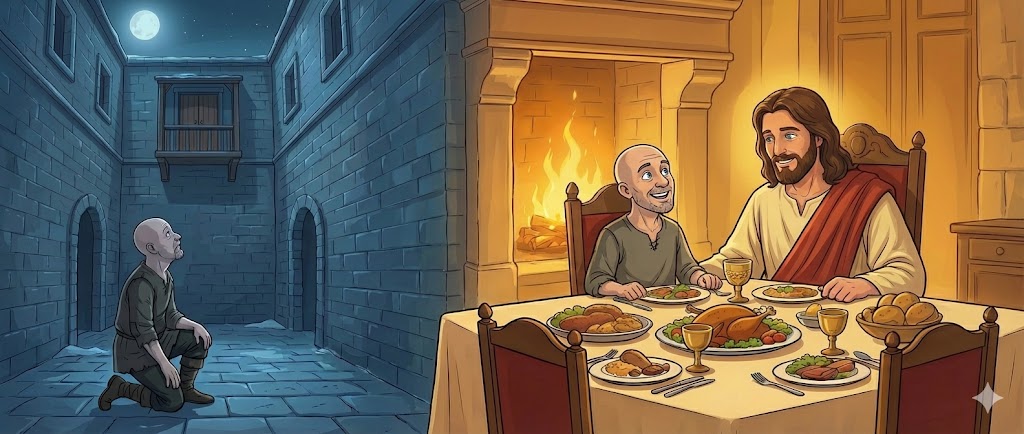
- Islam: You offer your life to God, hoping it is enough.
- Christianity: God offered His life for you, because He knew you weren't enough.
One system ends with a question mark ("I hope so"). The other ends with a period ("It is Finished") (John 19:30).
6. Conclusion
I respect the devotion of my Muslim friends. I really do. Their discipline is impressive.
But I have to look at what each faith actually teaches.
Islam asks me to believe that God let the whole world—including Jesus's own mother and disciples—believe He died on the cross. It asks me to believe God waited 600 years before sending a correction.
That would mean for six centuries God let millions worship Him based on a misunderstanding He had allowed.
Christianity says God was not silent. It says He made the truth clear on the day it happened. It fits the history we can read and the empty tomb we can point to.
One faith says God waited 600 years to tell us the truth.
The other says He told us the truth on day one: "It is Finished" (John 19:30).
That is the case.