






Is Evolution True?
To the students, the skeptics, and the "trust the science" crowd:
Is evolution true? If you see something very complex—like a smartphone or a car—you know someone designed it. It did not put itself together.
Yet in our culture, the main story for how life got here is evolution. We are told that the most complex information in the universe (DNA) wrote itself through random changes and time, with no designer.
Most adults believe this because they were told it is "settled science." But when you look at the evidence, serious problems show up.
In this paper we treat evolution as a claim and ask: does the evidence support it? We will give it a fair hearing. But the case against it is strong.
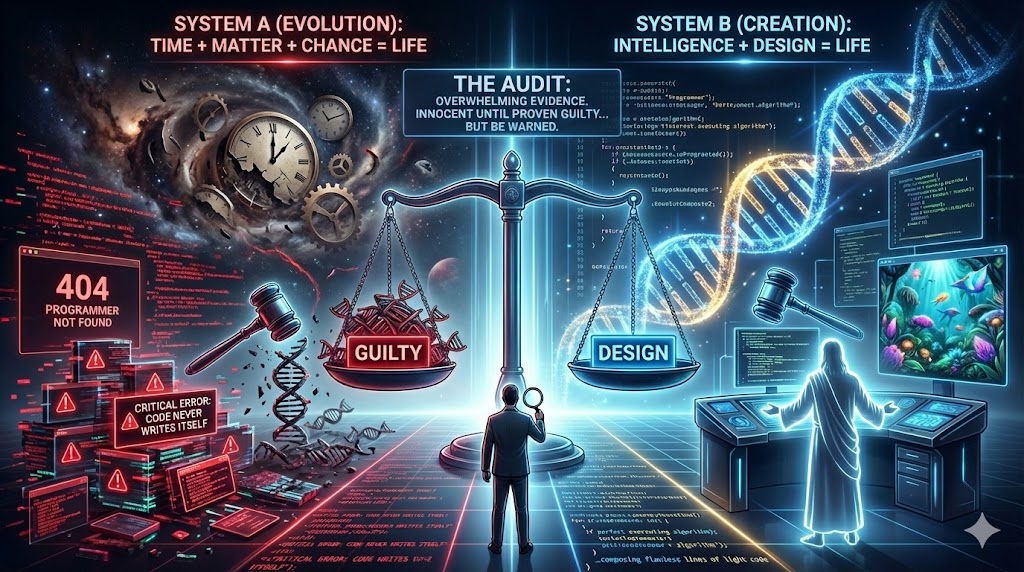
We are comparing two views:
- View A (Evolution): Time + Matter + Chance = Life.
- View B (Creation): Intelligence + Design = Life.
Here is the evidence.
1. Life Cannot Start From Non-Life
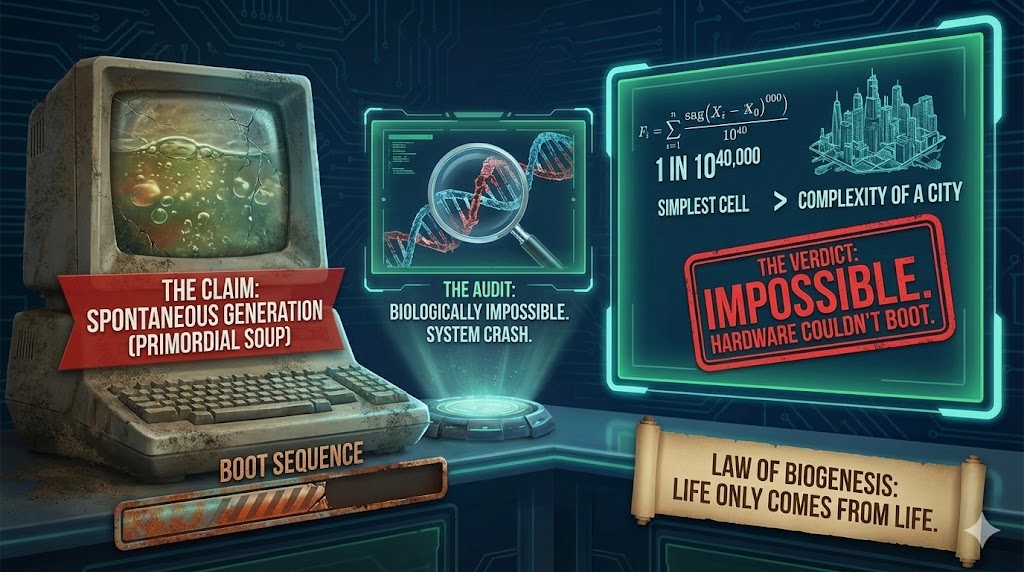
Before evolution can even start (natural selection), you first need life to select from. So where did the first life come from?
- The claim: Life arose on its own from non-living chemicals in a "primordial soup" billions of years ago.
- The problem: This goes against what we observe.
- The law: The Law of Biogenesis says that life only comes from life. We have never, in any lab, seen non-living chemicals turn into a living cell.
- The math: The simplest living cell is incredibly complex. It needs DNA, RNA, and proteins all working together. The chance of getting even one simple cell by random chance is something like 1 in 10^40,000.
- Bottom line: In math, probabilities beyond 10^50 are treated as "impossible." Life could not have started on its own. The story fails at the first step.
2. The Myth of "Good" Mutations
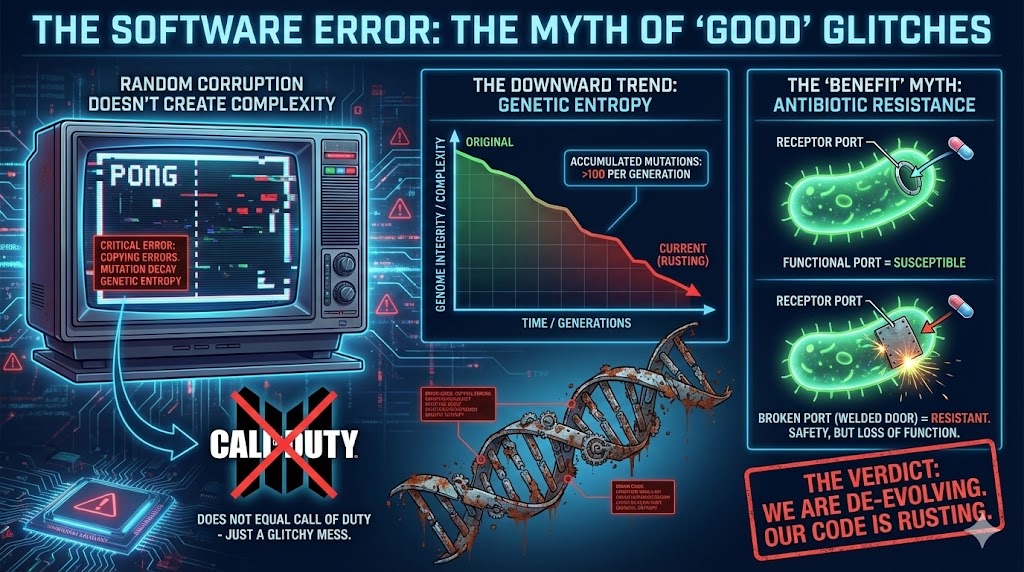
Evolution depends on mutations (copying mistakes) to add new information. The idea is that enough random changes could eventually turn a dinosaur into a bird.
- The reality: Random changes tend to damage information; they do not create it.
- The trend: The human genome is slowly accumulating damage. We get roughly 100 new mutations every generation. We are not evolving upward; we are losing information over time.
- The "benefit" myth: People point to antibiotic resistance as proof of evolution. But look closer. Bacteria often become resistant because they broke the part the antibiotic used to attach to. It is like welding your front door shut to stop burglars. You are safe from the burglar (the antibiotic), but you did not build a better lock—you just broke your door.
- Bottom line: Random damage to something simple does not turn it into something more complex. It usually just makes it broken.
3. The Fossil Record: Missing Transitions
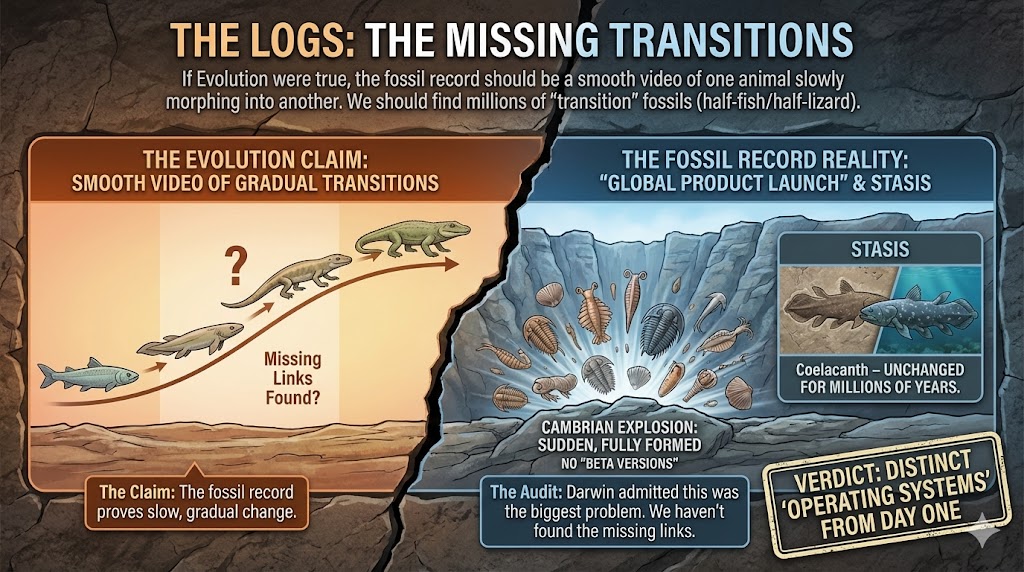
If evolution were true, the fossil record should show one kind of animal slowly turning into another. We should find lots of "in-between" fossils (half-fish, half-lizard).
- The claim: The fossil record shows slow, gradual change.
- The problem: Darwin himself said this was the biggest weakness of his theory. He hoped we would find the missing links later. We have not.
- The Cambrian Explosion: In the Cambrian layer of rock, almost every major animal body plan appears suddenly and fully formed. No clear ancestors. No gradual steps. It is like everything showed up at once.
- Stasis: When we find fossils of "ancient" creatures (like the coelacanth fish), they look the same as they do today. They did not change for "millions of years."
- Bottom line: We do not see half-formed kinds slowly turning into others. We see fully formed, distinct kinds appearing in the record, each complete from the start.
3.1 The Flood Connection: The "Great Unconformity"
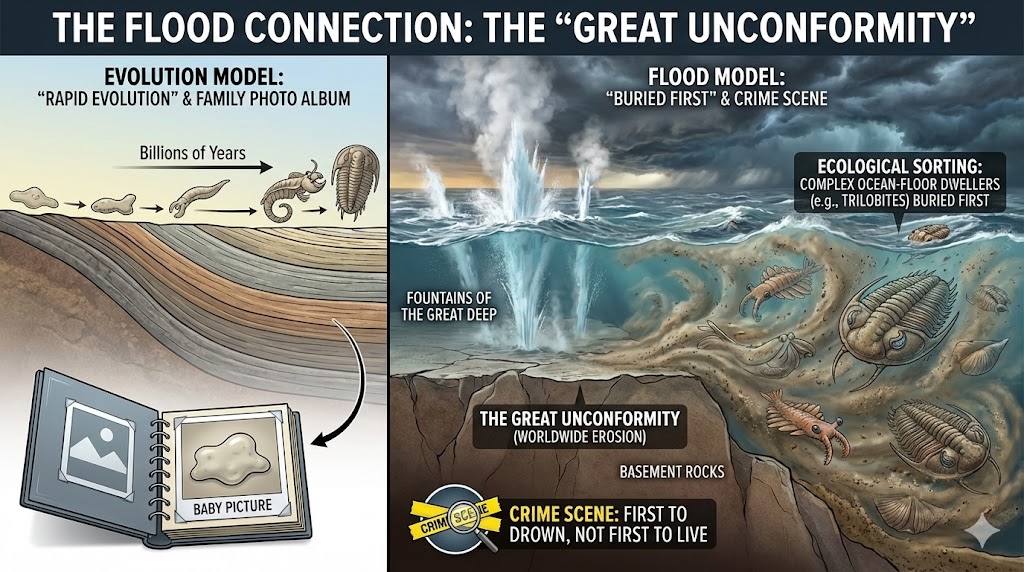
Why do all these complex sea creatures show up suddenly at the bottom of the fossil record? The evolution story says they "evolved rapidly." The Flood story says they were buried first.
- The data: Directly beneath the Cambrian layer, geologists often find the "Great Unconformity"—a huge, worldwide erosion surface where deep basement rocks were planed flat.
- What it may mean: This could match the violent start of a global flood (the "fountains of the great deep" in the Bible).
- Sorting by habitat: The Cambrian fossils are not "simple" organisms from billions of years ago. They are complex ocean-floor creatures (trilobites had compound eyes made of crystal calcite). They show up first in the rock record because they lived at the bottom of the sea. When a flood began, the ocean floor would be the first place buried by sediment.
Bottom line: Evolution reads the rock layers like a family album, as if the bottom layer is the "baby picture" of life. But the Flood view says those layers are more like a snapshot of the order things were buried. The Cambrian creatures were not necessarily the first to live; they may have been the first to be buried—complex ocean dwellers on the sea floor when the waters rose.
4. Shared DNA: Common Design vs. Common Ancestor
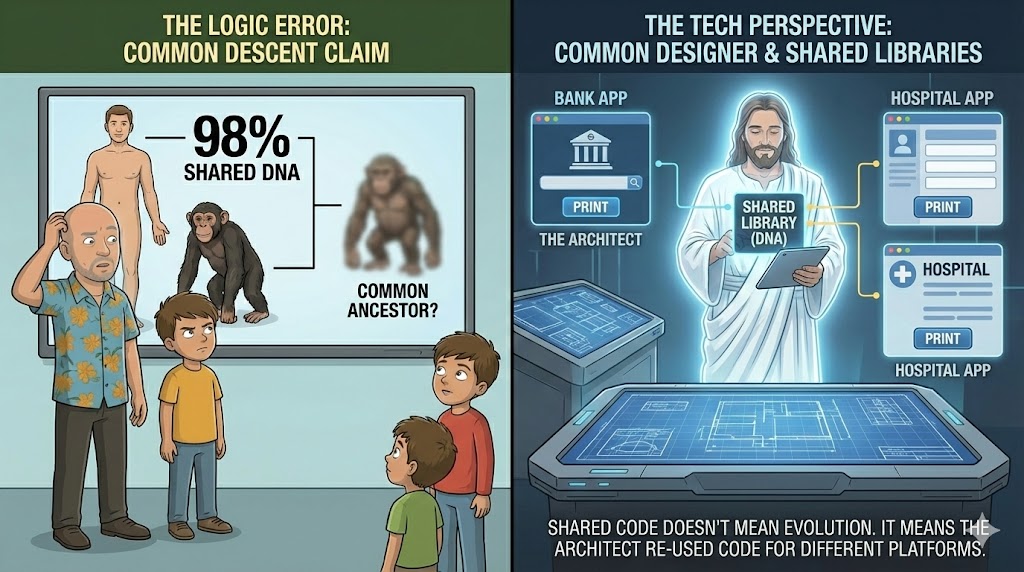
Evolutionists often say, "Humans and chimps share 98% of their DNA, so they must have a common ancestor."
- Another way to see it: Shared design can mean a shared designer.
- Same designer, different products: If one person designs a car and a truck, both might use the same kind of engine or steering parts. That does not mean the truck "evolved" from the car. It means the same designer made both.
- The Designer's signature: Shared DNA fits a common Designer just as well as a common ancestor. A designer might reuse the same working plan for digestion, breathing, and muscle movement in different creatures.
5. Irreducible Complexity
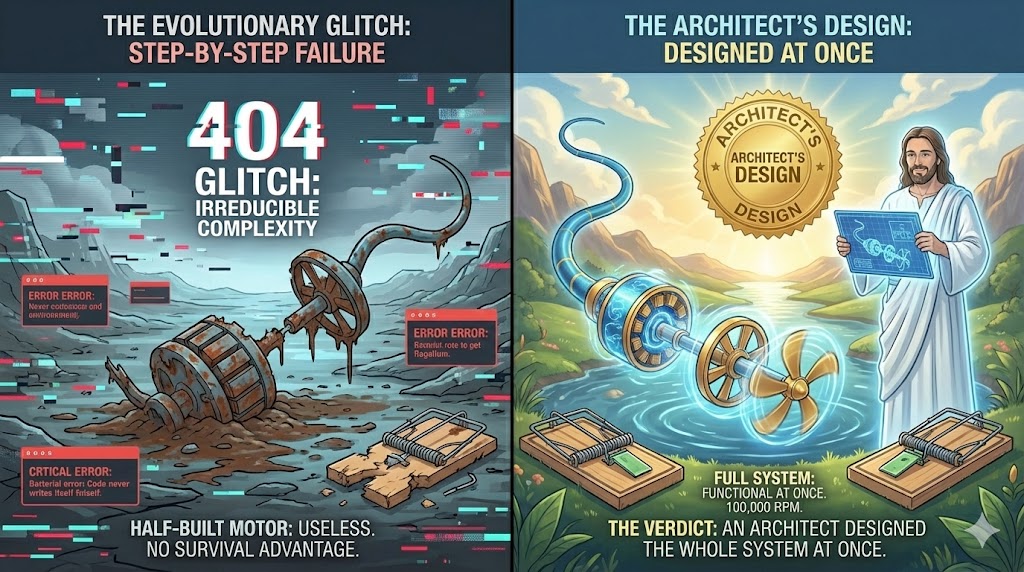
Some biological systems are like a mousetrap: if you remove one part (the spring), it does not work "a little bit"—it does not work at all.
- Example: The bacterial flagellum. This is a tiny, spinning motor that can run at 100,000 RPM. It has parts like a stator, rotor, drive shaft, and propeller.
- The problem for evolution: Evolution is supposed to work step-by-step, keeping only what helps. But a "half-built" motor is useless. It gives no advantage until all the parts are there and working. Evolution would have gotten rid of the "useless" parts long before the motor was complete.
- Bottom line: This fits a Designer who planned the whole system at once.
6. Conclusion: The Signature
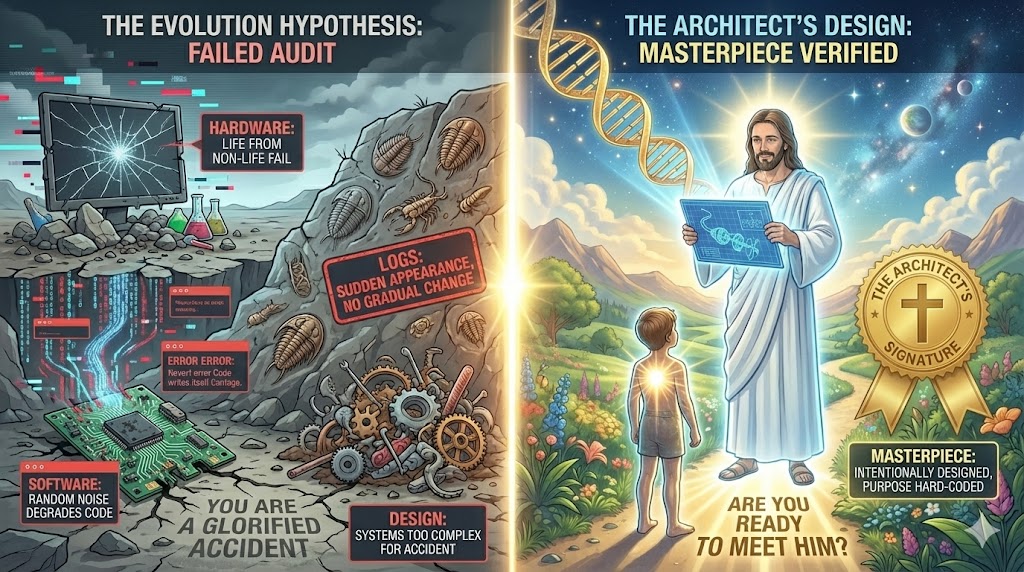
We have looked at the evidence. The evolution story fails the main tests:
- Origin of life: Life does not come from non-life.
- Mutations: Random changes do not build complex information; they damage it.
- Fossils: The record shows sudden appearance, not gradual change.
- Design: Many systems are too complex to be accidents.
The evidence points away from chance and toward a designing mind.
This is not just about winning an argument; it is about who you are. You are not a glorified accident. You are made on purpose, with a purpose written into your very being.
The Designer signed His work. Are you ready to meet Him?