






QTM 101What do the Hindus Really Believe?
What Do Hindus Believe?
To the reader:
What do Hindus believe? If someone asked you to define Hinduism right now, what would you say?
You would probably say something like, "Isn't that the one with millions of gods?" or "That’s the one with the blue elephant, right?"
Honestly, that was about all I knew, too.
So, I did what I always do: I looked into it. I did not want stereotypes; I wanted to understand what it actually teaches. I spent time reading and learning so I could see what this faith is really aiming for.
To be clear: I am not a guru. I am not an expert on Eastern philosophy. I am someone who likes to take ideas apart to see how they work.
What follows is what I found. It is a basic look at one of the world's oldest faiths, compared with the Christian worldview.
I am just sharing what I learned. You can make of it what you will.
"Test everything. Hold on to the good."
(1 Thessalonians 5:21)
1. Why Is Everything Broken?

You do not need a PhD to know the world is broken. You just need to watch the news for five minutes. Or try to keep a white shirt clean for a whole day.
There is a gap between the world as it is (suffering, wrongs, mess) and the world as it should be (peace, justice, order). We all feel it. It is like a splinter in the mind.
1.1 The Science of Decay
Physics actually has a name for this frustration: Entropy.
According to the Second Law of Thermodynamics, all closed systems tend toward disorder over time. Energy disperses. Things break. We see this everywhere:
- The Universe: Stars burn out. Orbits decay.
- Your Body: You used to be able to jump off a swing set. Now you sleep wrong and your neck hurts for three days.
- Your Garage: You never have to work to make your garage messy. It does that all by itself. You have to work to bring Order back.
1.2 What We Feel Inside
Here is the strange part: We hate this.
If decay were truly "natural" to us, we would accept death and suffering the way a fish accepts being wet. It would not bother us.
But we push back. We cry at funerals. We want justice when things go wrong. Something inside us says, "This is not how it is supposed to be!"
So how do we fix what is broken? History basically offers two main answers:
- The "do-it-yourself" way (Hinduism/Karma): Things can be set right, but you have to do it. You messed up, so you have to fix it. If it takes a million lifetimes of trial and error, so be it.
- The "rescue" (Christianity/Grace): The problem is too big. You cannot fix it because you are the one who is broken. God has to step in and do the work for you.
2. God: Force vs. Person
2.1 Hinduism: The Cosmic Force (Brahman)
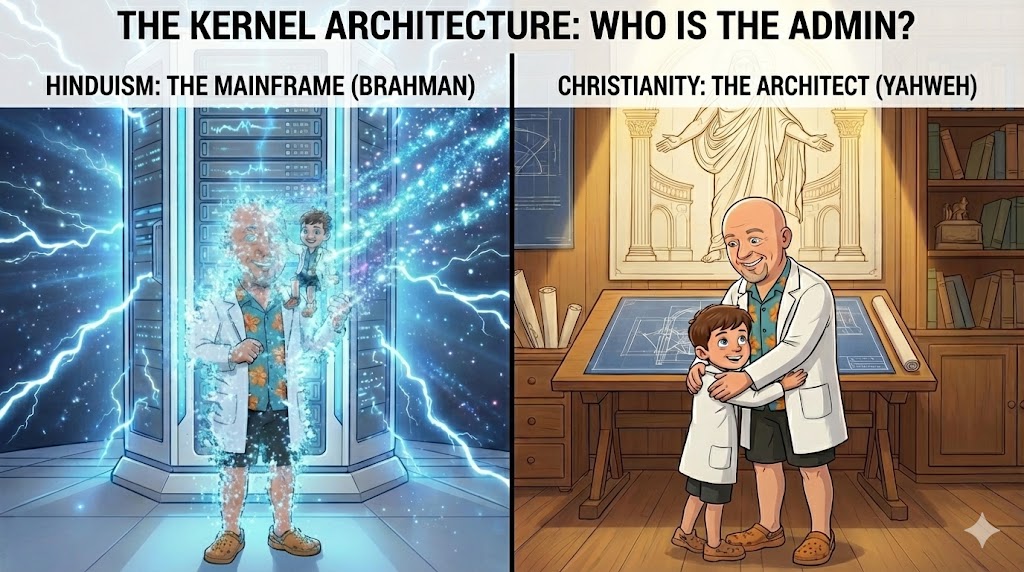
In the Hindu view, the ultimate reality is Brahman. This is not a "God" you can talk to. It is an impersonal force—like electricity or gravity.
The goal of Hinduism is Moksha (liberation). It teaches that your individual self is basically an illusion. The goal is to see that you are part of this force and merge back into it, like a drop of water returning to the ocean (Upanishads).
Think about it:
You cannot have a relationship with electricity. You can respect it—you do not want to get shocked—but you cannot love it.
- You do not write poetry to a battery.
- You do not send Valentine's cards to the power company.
If God is just "energy," then love has no real object.
2.2 Christianity: A Personal God
Christianity teaches that the Creator is separate from creation, like a painter is separate from the painting. The Bible describes God as a person—a mind with a will, emotions, and a character (Exodus 34:6-7).
So:
If God is a person, then the goal is not disappearing into the force; it is relationship with Him.
When my kid runs to me, I do not want him to vanish into me. I want to hug him. The Christian hope is that your identity is not a mistake to be wiped out; it is something to be restored.
3. Karma vs. Grace
3.1 Karma
Karma is essentially Newton’s Third Law applied to morality: "For every action, there is an equal and opposite reaction" (Newton's Principia Mathematica).
It sounds great because it’s "Fair." If you do good, you get good. If you do bad, you get bad.
- The problem: The standard is perfection.
- The trap: If you have ever been selfish, angry, or rude, you have built up "debt." In karma, there is no forgiveness—only paying it off.
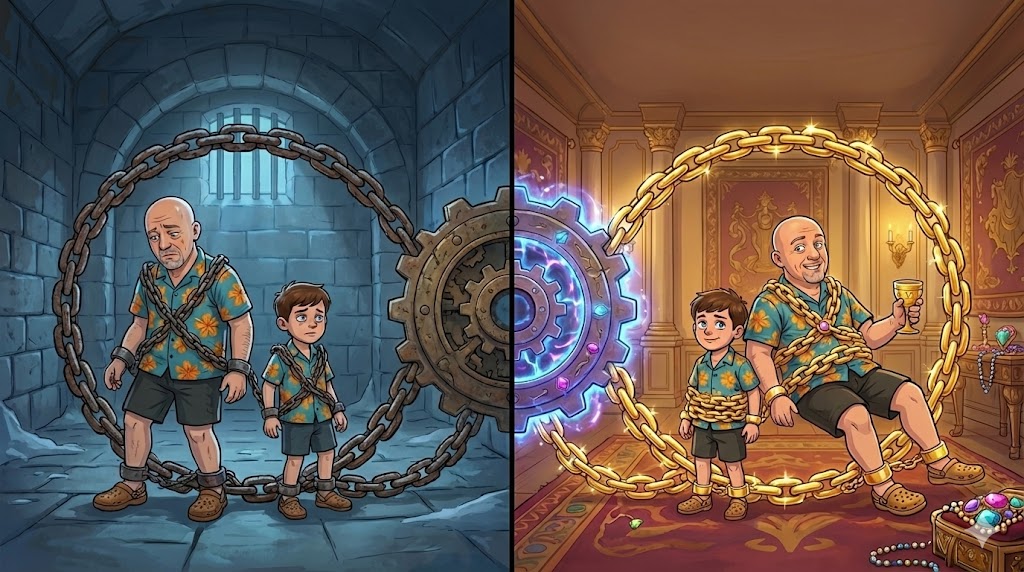
The golden handcuffs:
We might think the goal is "good karma" (being reborn rich or successful). But a comfortable life can be a trap. If you are rich and happy, you enjoy the world so much that you forget to let go.
- Bad karma creates iron chains (suffering).
- Good karma creates golden chains (pleasure).
Both keep you stuck in the cycle. You are just decorating your cell.
3.2 Grace
Christianity offers something that does not fit the usual rules: grace.
If I owe a million dollars, the bank does not care if I "try harder" next month. The only way to clear the debt is for someone else to pay it.
The Gospel says that Jesus came into the world to take the punishment for what we did wrong. He took the death and the moral debt on Himself (2 Corinthians 5:21).
- Karma says: "You broke it, you buy it."
- Grace says: "You broke it, I bought it."
4. The Timeline: Cycle vs. Arrow
4.1 The Reincarnation Trap
Reincarnation is often presented as a "second chance," but if you look at how it works, it can feel like a trap. You keep coming back into a world that runs down.
Think of the "Wheel of Samsara" (the cycle of rebirth). It is an up-and-down cycle:
- Suffering: You are born poor. You are humble. You pray. You generate Good Karma.
- Success: You are reborn wealthy.
- Arrogance: You get comfortable. You stop praying. You enjoy the yacht. You generate Bad Karma.
- Crash: You are reborn poor again.
You are not climbing a mountain; you are on a hamster wheel.
Think about it: Is humanity getting morally better over thousands of years? We have faster ways to do the same old wrongs. That is not progress.
4.2 The Resurrection
Christianity sees time as an arrow, not a loop. You have one life, one death, and then judgment (Hebrews 9:27).
The promise is not to be recycled into another body; it is to be raised in a new, perfected body.
Jesus showed this when He rose from the dead—He came back in a real body, able to be touched and to eat (Luke 24:41-43), yet He could also pass through walls. He was raised in a new way. The goal is not to escape the physical world; it is for it to be made right.
5. The Pilot vs. the Passenger

5.1 The "Solo Flight" Problem
In Hindu teaching, the rule of Antya-kale says that where you end up is decided by your state of mind at the exact moment of death (Bhagavad Gita 8.6).
The problem:
That makes you the pilot of your own soul at the hardest moment of your life. You have to "get it right" while your body is failing.
- What if you panic?
- What if you are on medicine or out of it?
- What if you are unconscious?
If your fate depends on you having perfect focus at the moment of death, then your security is only as strong as your own mind. And minds are fragile.
5.2 The "Passenger" Status
Christianity paints a different picture.
When you trust Jesus, you are not the pilot. You are the passenger.
- Hinduism: The outcome depends on how you do at the end.
- Christianity: The outcome depends on the one you trusted—Jesus.
In one view, you must save yourself at the last moment. In the other, you are already safe before the "plane" even lands. The choice is which pilot you trust: yourself, or Him.
6. Conclusion
If you love the idea of "fairness," Hinduism is a serious, consistent system. It is logical and balanced—and for many, that is what makes it scary.
It is the ultimate "you get what you pay for" picture.
But I have to look at the risks.
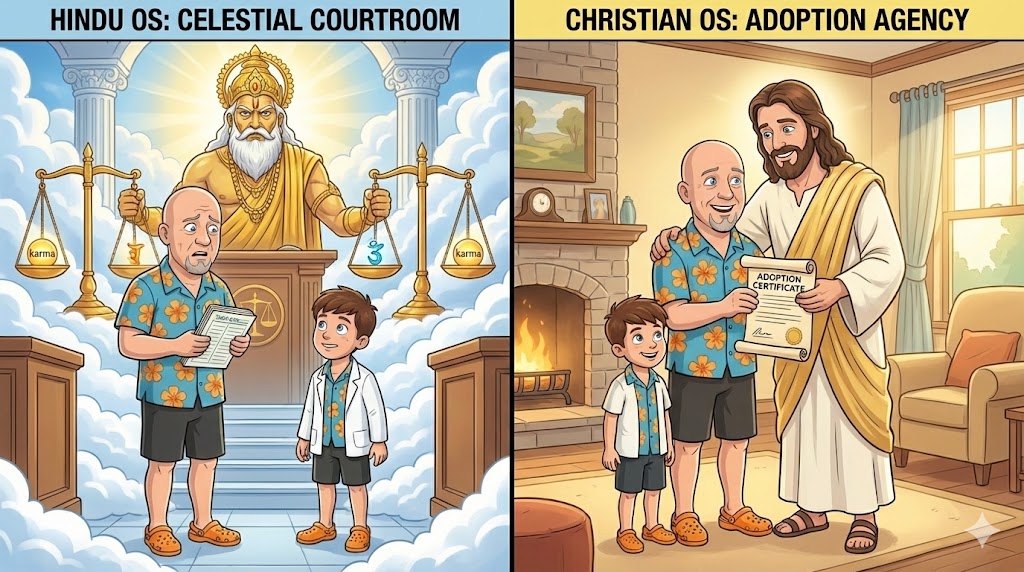
If I rely on karma, I am betting my eternity on my own performance. I am betting my good days will outweigh my bad. And when I look at my own life—my pride, my selfishness, my failures—that is a bet I am almost certain to lose.
I do not want justice. Justice would destroy me.
Christianity offers something different. It is not a wage you earn; it is a gift you receive.
If I am standing before God, I do not want the Judge to look at my record and give me what I deserve. I want Him to look at Christ's record and treat me as He deserves.
That is the offer.
You can choose the "fair trial" of karma, or the gift of grace.
The comparison is done. The choice is yours.
That is the case.